Microsoft released around 200 vulnerabilities at once in its regular security update on June 9, 2026. This was the largest monthly security update since the introduction of Patch Tuesday in 2003.
Now, enterprise security teams are faced with a list of around 200 vulnerabilities at a time, rather than dozens a month, and must decide "what to block first."
But the bigger issue is not the number of patches. The real problem is that the time it takes for exploit proof-of-concept code to be created after a patch is released has shrunk dramatically.
According to Anthropic's report released on June 8, 2026, 'The Impact of LLMs on N-day Exploits,' the Mithos model generated working exploit code less than an hour after a Firefox security patch was released.
Looking at the timeline makes the change clearer. In the past, it took significant time to exploit a vulnerability after disclosure. Companies had time to review, test, and deploy patches. Recent security reports shows this window is rapidly shrinking.
Some security communities estimate the time from disclosure to exploit has shrunk from hundreds of days to mere hours. Attackers no longer wait. Once a patch is released, they reverse-engineer it to find the fixed flaw. And AI is making that process even faster.
Unrealistic to fix all 200
That is where the issue begins. Once 200 vulnerabilities are exposed at once, no firm can finish patching them all in a day. It is not because the security team is lazy. It is practically impossible.
To apply a patch, you must first check if your system has that vulnerability. You need to see if you use the software, what version it is, if it is exposed externally, and if it is linked to internal systems. For active services, you must check for downtime risks. Systems that cannot stop easily—like manufacturing, finance, government, or healthcare—find patching even harder.
Thus, security teams face the same inquiry.
"When do we fix all 200?"
Treating all flaws with equal weight soon paralyzes the team. The real question to ask is different.
"Which of these could actually lead to a breach today?"
This is the inquiry to answer. High-score flaws are not always the most urgent. Conversely, a lower-score flaw on a web-exposed server with public exploit code, linked to customer databases, can be far more dangerous.
For instance, Flaw A has a high risk score but sits in a private net with no outside access and extra MFA. Flaw B has a lower score but sits on a public web server, has open exploit code, and leads to internal database assets. Here, you must fix B first, not A.
Security should not just stop at asking "Is there a flaw?" We must ask, "Can that flaw lead to an actual attack in our environment?"
Prioritizing in the Era of Patch Explosions
Continuous Threat Exposure Management (CTEM) is not a "one-and-done" security check, but a continuous cycle of measuring and reducing exposure.
Granted, CTEM is not a patching tool. Nor is it a magic bullet that auto-fixes 200 vulnerabilities. Instead, CTEM helps security teams decide "what to fix first."
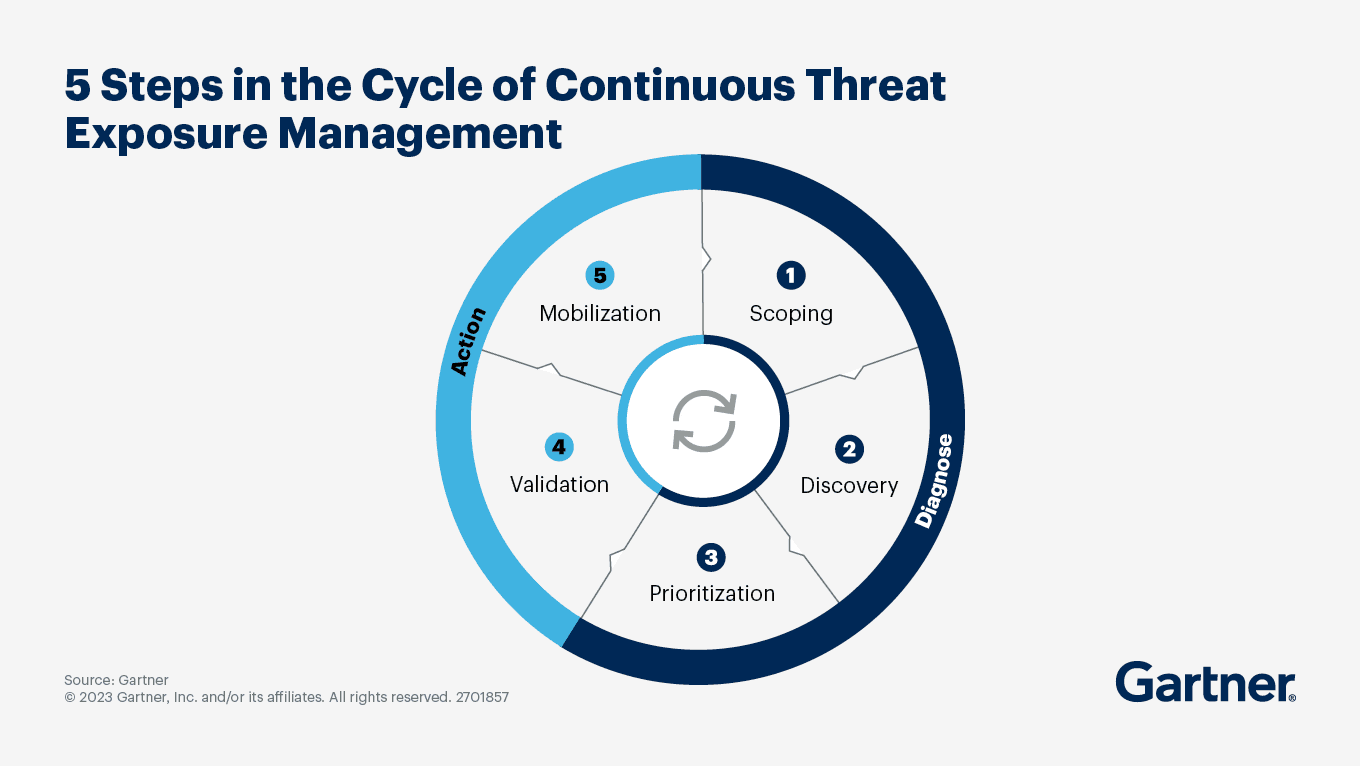
The core of CTEM consists of five stages. First, scoping defines what needs protecting. Second, discovery finds exposed assets and weaknesses within that scope. Third, prioritization narrows down the discovered risks based on actual exploitability. Fourth, validation verifies if those risks can truly be breached. Lastly, mobilization translates validation results into actual remediation.
Through this process, a list of 200 vulnerabilities changes from a flat spreadsheet into an actionable security roadmap. It distinguishes "vulnerabilities to patch today," "vulnerabilities to remediate this week," "vulnerabilities requiring temp workarounds," and "vulnerabilities with low exploit risk that can wait."
If security teams cannot patch every vulnerability at once, they must block the paths attackers are most likely to exploit first. CTEM is how you find those paths.
An inspect-once-or-twice-a-year pace cannot keep up
Faced with this speed, traditional security audits reveal historical design flaws. Running scheduled reviews like annual penetration tests or quarterly scans leaves vast gaps between checks. When exploits emerge hours after patch releases, systems checked semi-annually remain exposed and undefended nearly the entire time.
In the past, asking "Did we do our regular scan?" was enough. Today, the question must change. We must ask: "Are we verifying right now that our systems cannot be breached by an active attack?"
A pivotal phase in CTEM is validation. Scans merely highlight potential flaws; patch lists show what needs updating. But that is not enough. You must actively test if an attacker can exploit those flaws to get in, if security controls block them, or if chained flaws create an active intrusion path.
This is exactly what CTEM highlights. The goal is not patching every loophole at the same speed. It is finding, validating, and mitigating high-risk threats first. If you cannot fix all doors at once, lock the ones that attackers can breach tonight.
If AI white hackers verify daily, everywhere
This is where the frequency and scope of validation become crucial. Manual penetration testing by humans is precise, but has clear limits in the scope and frequency of what can be checked at one time. A company’s IT environment is constantly changing, with new servers spawned, cloud settings modified, APIs added, and external partner systems integrated. If security validation remains stuck in the state it was six months ago, it cannot explain today's risks.
AI-driven white-hat hacker operations complement this limitation. Instead of inspecting a fixed part of the system a few times a year, validation can be run again whenever changes occur, new assets are added, or new vulnerabilities are disclosed. The key is not to stop at a one-time check. We must minimize the blank space left until the next assessment.
If attackers use AI to weaponize patches faster, defenders must also use AI to validate their systems quicker. If an attacker can create exploit code within an hour, defenders must verify within that same hour whether "this vulnerability can actually be exploited in our system." Although this speed asymmetry may not disappear completely, closing that gap becomes the new baseline of defense.
Validation is crucial even when patches cannot be applied immediately. If an actual attack capability is confirmed, the security team can apply temporary defense measures first, such as blocking access, changing firewall policies, applying WAF rules, restricting account privileges, disabling vulnerable services, adding detection rules, or isolating networks. While a complete patch is best, cutting off the attack path first is also a critical defense when patches are delayed.
Ultimately, CTEM and AI white-hat hacker validation reduce the frustration of security teams facing 200 vulnerabilities. It shifts the state from "we don't know what to fix" to "this is the highest risk we must mitigate first today."
In an environment where 200 patches flood in at once and which ones will be attacked first is determined in hours rather than days, "continuous validation" holds far greater value than "occasional checks."
In an era where AI has compressed attack speeds to an hourly scale, defense must also shift from fixed schedules to a continuous cycle. Defining what to protect, finding exposure, prioritizing, validating actual exploitability, and translating those results into action must become an ongoing, repeating cycle rather than a one-off event.
References
Anthropic, “Measuring LLMs’ impact on N-day exploits”, 2026.06.08
Zero Day Initiative, “The June 2026 Security Update Review”, 2026.06.09
Microsoft Windows Blog, “Reflecting on 20 years of Windows Patch Tuesday”, 2023.11.09
CTEM.org, “Continuous Threat Exposure Management: A Definitive Guide”
Team Cymru, “What is Continuous Threat Exposure Management?”
Anthropic, “Project Glasswing: Securing critical software for the AI era”, 2026.04.07
Anthropic, “Project Glasswing: An initial update”, 2026.05.22
Anthropic, “Making frontier cybersecurity capabilities available to defenders”, 2026.02.20
Popular Articles


More Articles




" height="209.99999944452435px" id="s16LUEeu4" width="425.00001613409887px"/></svg>)