
The year 2025 will likely be long remembered in the history of South Korean cybersecurity. Major incidents have occurred across communications, finance, and platforms, resulting in millions of personal data leaks from large corporations to small businesses.
SK Telecom suffered a data breach of over 26 million customer records due to an old Linux vulnerability that had not been fixed for more than 8 years, while illegal femtocells infiltrated KT's internal network, triggering ongoing micro-transactions. Lotte Card became a 'secret passage' for hackers by missing a security patch that should have been applied in 2017.
Recently, another incident occurred at Coupang. A former employee exploited their retained permissions and weaknesses in the server authentication structure to access vast amounts of customer information without following normal login procedures. Sensitive information like names, contact details, and addresses was leaked from over 30 million accounts.

caption - Security incident news capture
The reason that telecommunication companies, card companies, and even everyday platform companies for the public were breached in succession is not simply due to bad luck. Although they seem like different incidents on the surface, a common pattern emerges upon closer inspection.
The attacks had been underway for quite some time, but companies were unaware and continued to operate their services as usual. The reassurance stemming from “We have the minimum equipment and regulations required by law, so we're fine,” and the naive hope of “Surely, our company won't be hit?” were brutally shattered throughout 2025.
John Chambers, the former CEO of Cisco in the US, once said:
“There are two types of companies: those that have been hacked and those that have been hacked but don't know it yet.”
After witnessing the events in Korea this year, it becomes clear that this statement is no longer an exaggeration.
What 2025 reveals: outdated systems and the mindset that 'security is a hassle'
Our security system was designed around regulations and guidelines created in the early 2000s when the internet and IT services were just beginning to expand. Since then, the world has drastically changed with cloud computing, mobile, platforms, subscription services, and startup ecosystems, but many organizations' security still largely remains tied to a 'checklist approach.'
Security officers fill out checklists for reports, and management finds solace in asking, 'Have we done all the mandatory tasks?' However, hackers do not read these documents. They persistently exploit real-world gaps such as delayed server patches, forgotten accounts left open for testing, and conveniently relaxed authentication rules.
Long-standing vulnerabilities in SK Telecom, patches missed by Lotte Card, and authentication weaknesses in Coupang are examples that clearly show how easily and for how long these gaps can be neglected.
Underlying all this is the sentiment that 'security is inconvenient and costly.' Because it's not visible or obvious in everyday operations, it is always relegated to the back in terms of budget and resources. When an incident occurs, regrets like 'We should have paid more attention back then' rush in all at once. The year 2025 starkly revealed how deeply this structural complacency and fatigue had accumulated.
Just minimal defense isn't enough
One of the key terms in the security industry these days is 'Zero Trust.' As the name suggests, it is the principle of "basically trust no one and always verify." Internal company users are not automatically trusted, nor are incoming requests from outside blocked indiscriminately. Instead, it continuously checks who is accessing which system, whether the authorization is truly necessary, and if there are any unusual signs that differ from the norm.
However, simply declaring a principle does not automatically change the system. There is always a gap between policies written on paper and the actual implementation in servers, clouds, and work systems. It is necessary to consistently monitor whether the principles are being upheld. One way to reduce this gap is through penetration testing and red team exercises.
Offensive security, in simple terms, is “hacking ourselves before hackers come.” White hat hackers examine the company’s system like real attackers, attempt penetration, and see how far they can climb. During this process, issues such as "Why has this server patch been delayed for years?" or "Nobody knows whose account this is, but it still has administrator privileges," become apparent.
The important point is that these hacking rehearsals go beyond merely identifying technical vulnerabilities. They provide a basis for management accountability by demonstrating “we have prepared as much as possible in advance.” Saying “we did our best” after an incident occurs carries a different weight than showing records of having regularly conducted penetration tests and red team exercises to discover and fix vulnerabilities. Moving forward, this kind of ‘preparation’ will impact not just regulatory measures but also management evaluations and investor trust.
'Era of AI becoming the operating system of attacks'… A bigger wave is approaching
The issue is that this is not the end. According to reports from the global security industry, another keyword is expected to emerge in the threat landscape after 2026. The forecast is that 'AI becomes the engine driving the entire attack.'
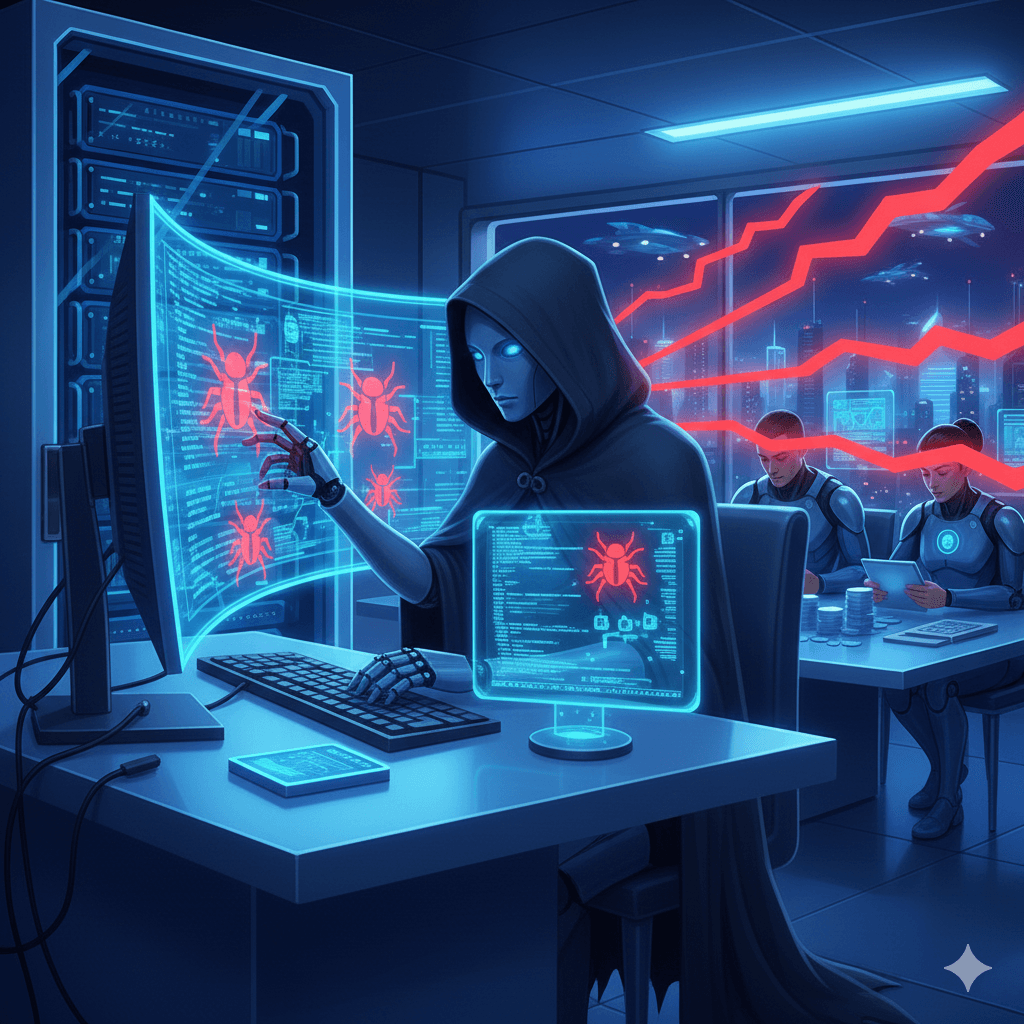
caption - Global companies warned that AI would become the engine driving the entire attack. (Image created by Google Gemini)
Until now, hacking has felt like the domain of a few experts with advanced skills. However, the situation may change in the future. Attackers will ask AI to 'find the weak spots of this company and create an intrusion path,' instead of writing their own code and setting up infrastructure. AI can investigate targets based on internet and exposed system information, find known vulnerabilities, infiltrate and escalate privileges, extract data, and even automatically draft ransom messages.
The risk will increase, especially when 'AI agents' which autonomously plan and execute tasks begin to be widely used. In an environment where AI agents handle tasks such as inventory management, reconciliation, customer service, and code deployment, a single mistake or manipulation by attackers can impact logistics, production lines, and accounting systems in sequence. Scenarios where corporate AI tools and agents are compromised, allowing indirect infiltration, become reality without breaching the internal network directly.
Moreover, supply chains like software, open-source, AI model repositories, misconfigured cloud storage and exposed APIs, and GPU infrastructure shared by multiple companies are all opening as new attack surfaces. Ransomware is also evolving by using AI to automatically calculate 'what information this company fears the most' and 'what data should be threatened to be disclosed to inflict critical damage on regulations, reputation, and stock prices.'
AI is not just enhancing existing attacks a bit faster, it is elevating the scale, speed, and sophistication of attacks to a completely different level. Large incidents we observed in 2025 may be just precursors.
In 2026, a security system overhaul is needed
In this trend, Korea's security system must also shift significantly. The first shift is from “security that detects and blocks” to “security that anticipates and recovers quickly.” AI-based attacks are so swift and automated that by the time anomalies are detected, data may already have been leaked or the system tampered with.
Going forward, it will be crucial to conduct ongoing checks on 'Exposure Management'—understanding what weaknesses exist within our organization, how they appear externally, and where attackers might aim first. Simultaneously, it is vital to establish a system to “repeatedly train before real attacks occur” by employing red teams and penetration testing that act like real attackers, along with partially automated tools.
Additionally, recognizing AI itself as an important focus of security is necessary. Like humans, AI agents should be granted unique IDs and minimal permissions, with records kept of their actions. Essential tasks involving significant amounts of money and data should have a structure where a human reviews them lastly.
Moreover, security personnel and investments should be transparently disclosed rather than hidden. Publicly sharing information such as “how many security personnel we have and what investments are being made” should function like a kind of management report card. This transparency can make the security industry an attractive career option for talented individuals, and allows citizens and investors to judge how committed a company is to security.
Reflecting on Korea's cyber threats in 2025, there's a simultaneous feeling of despair at having hit rock bottom and urgency that “things cannot remain the same.”
Examples from SK Telecom, KT, Lotte Card, and Coupang signal the end of the era when security was viewed as a minimal cost concern. The global predictions of AI-based attacks serve as warnings that a much fiercer storm is heading our way.
We are at a crossroads now. The year 2025 could just be remembered as the “worst year for security.” However, it could also be the starting point where we began to completely overhaul our security consciousness and systems.
Instead of resigning to “We will get hit someday,” we should ask, “What will we change today in preparation for someday?” We must shift from “reactive security after a hacking incident” to “proactive security by self-testing before being hacked.” We must aim to become a “country preparing first for a security paradigm suited to the AI era” rather than a “nation dragged by AI attacks.”
Popular Articles


More Articles



" height="209.99999944452435px" id="s16LUEeu4" width="425.00001613409887px"/></svg>)